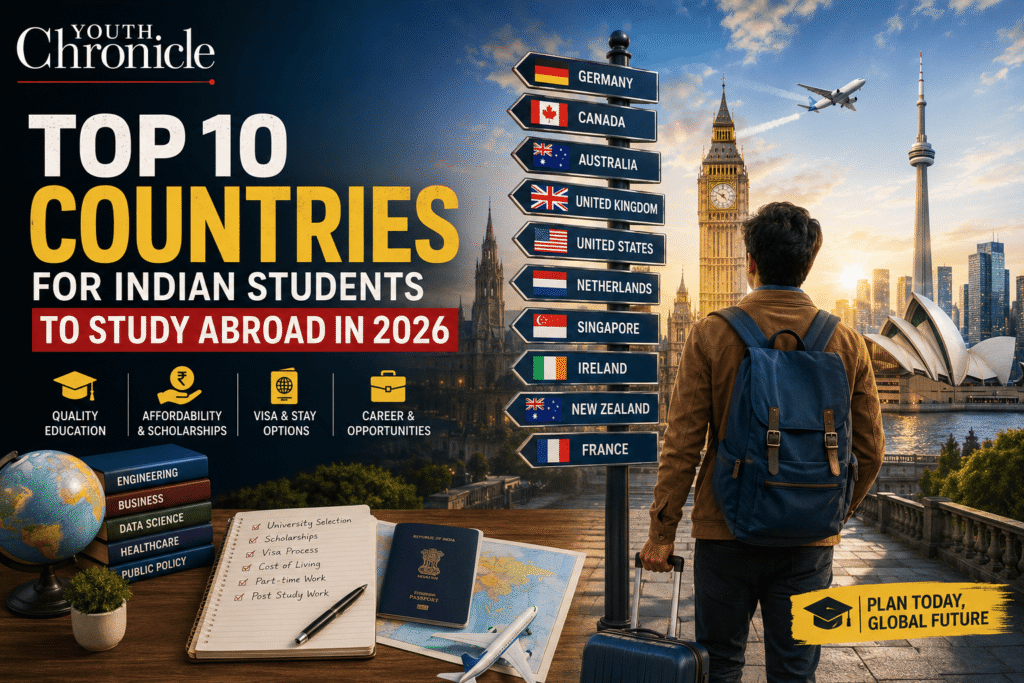
Studying abroad has become a major aspiration for Indian students looking for international academic exposure, specialized courses, research opportunities and global career experience.
But choosing a country in 2026 is more complicated than simply looking at university rankings.
Students now have to consider tuition fees, living expenses, scholarships, visa policies, part-time work rules, post-study work options, employment prospects and long-term career plans.
This is particularly important because immigration and international-student policies are changing in several major destinations. Canada has introduced tighter controls on international student numbers, the UK is reducing the duration of its Graduate visa for applications from 2027, and Australia has also changed its international education and graduate-visa framework.
So, which are the best countries for Indian students to study abroad in 2026?
Here is a practical comparison of 10 destinations worth considering.
How We Selected These Countries
There is no official global ranking for the “best countries for Indian students.”
For this guide, the destinations are assessed based on:
- Quality and reputation of higher education
- Range of courses and universities
- Relative affordability
- Opportunities for international students
- Post-study work options
- Employment prospects
- Research and innovation
- English-language accessibility
- Overall suitability for Indian students
The ranking is therefore intended as a practical guide, not an absolute league table.
1. Germany: One of the Best Choices for Affordable Higher Education
Germany has become increasingly attractive to international students, particularly those interested in engineering, computer science, technology, research and other STEM fields.
One of its biggest advantages is affordability. Most public universities do not charge conventional tuition fees, although students generally pay semester contributions and exceptions exist, including at some institutions and programmes.
Germany also has a strong industrial ecosystem, particularly in engineering, automotive technology, manufacturing and applied research.
For Indian students, Germany can therefore offer an attractive combination of academic quality and comparatively low tuition.
However, students should not assume that every programme is taught in English. Learning German can significantly improve everyday life, internships and employment prospects.
International students applying for a German study visa must also demonstrate sufficient financial resources. The official German government portal currently lists a minimum blocked-account requirement of €11,904 for 2026.
Best for: Engineering, computer science, research, automotive, data and STEM.
2. Canada: Strong Education and Career Opportunities, but With Tighter Rules
Canada has historically been one of the most popular destinations for Indian students because of its universities, multicultural environment and opportunities to gain Canadian work experience.
However, Canada in 2026 is not the same study-abroad market it was a few years ago.
The Canadian government has introduced an annual cap on study permits and announced further reductions in new international student arrivals for 2026-2028.
Students also need to pay close attention to Post-Graduation Work Permit rules. For students in non-degree programmes, eligibility can depend on whether the programme falls within an eligible field of study linked to labour-market priorities.
That does not make Canada a poor choice.
It means students need to choose their institution and programme much more carefully.
Canada remains attractive for students seeking strong academic programmes, multicultural communities and potential post-study employment.
Best for: Computer science, business, engineering, healthcare, finance and technology.
Important: Do not choose Canada solely because of an assumed PR pathway. Immigration outcomes depend on current rules, occupation, province, qualification and individual circumstances.
3. Australia: Strong Universities, Quality of Life and Graduate Work Options
Australia remains one of the major destinations for Indian students.
Its universities have strong international reputations, while cities such as Melbourne, Sydney, Brisbane, Perth and Adelaide offer large international student communities.
Australia is particularly attractive for students interested in engineering, information technology, business, healthcare, environmental sciences and research.
The Temporary Graduate visa also provides eligible graduates with an opportunity to remain in Australia after completing their studies. The current Post-Higher Education Work stream generally allows two to three years, depending on the qualification.
However, Australia has also tightened aspects of its international education system, and visa costs and requirements have changed.
The official Australian government data shows that international student numbers in the first five months of 2026 were below the corresponding period in 2025, demonstrating that the market is changing.
Best for: Engineering, healthcare, IT, business, environmental studies and research.
4. United Kingdom: Excellent Universities and Shorter Master’s Degrees
The United Kingdom remains a major choice for Indian students because of its globally recognised universities and comparatively short postgraduate programmes.
A major attraction is the availability of many one-year master’s programmes, allowing students to complete postgraduate education faster than in several other countries.
The UK is particularly strong in:
- Business and management
- Finance
- Law
- Engineering
- Computer science
- Data science
- Artificial intelligence
- Social sciences
However, students planning to study in the UK in 2026 need to understand an important Graduate visa change.
Under current rules, graduates applying for the Graduate visa on or before 31 December 2026 can receive two years of permission. For applications made on or after 1 January 2027, the standard duration will fall to 18 months. PhD and other doctoral graduates remain eligible for three years.
Therefore, students should not base their decision on outdated claims that every UK graduate automatically receives a two-year post-study work period.
Best for: Finance, business, law, technology, engineering, research and humanities.
5. United States: The Strongest Option for Research and Technology
The United States remains one of the world’s strongest destinations for higher education, particularly for students targeting elite universities, research-intensive programmes and technology careers.
American universities are particularly influential in areas such as:
- Artificial intelligence
- Computer science
- Data science
- Engineering
- Biotechnology
- Business
- Economics
- Research
For students pursuing qualifying STEM degrees, the US offers a potentially significant post-study work advantage through the STEM OPT extension.
Eligible F-1 students can receive a 24-month STEM OPT extension after the initial period of post-completion OPT, subject to the relevant requirements.
The major disadvantage is cost.
Tuition and living expenses at many American universities can be substantially higher than in countries such as Germany.
Students therefore need to compare scholarships, assistantships, tuition and expected career outcomes rather than focusing solely on university rankings.
Best for: AI, computer science, engineering, research, biotechnology, finance and business.
6. Ireland: An Attractive English-Speaking European Destination
Ireland has become increasingly relevant for students looking for an English-speaking European education destination.
The country has strengths in computer science, IT, business, finance, engineering and life sciences. Ireland also hosts European operations of several major multinational companies.
Education Ireland highlights Ireland’s industry connections and strengths in areas including computer science, business, engineering and healthcare.
Ireland also provides post-study opportunities through the Third Level Graduate Programme.
Graduates with Level 8 qualifications can receive up to 12 months of graduate permission, while eligible Level 9 or higher graduates can receive up to 24 months, subject to the applicable conditions.
International students should also understand that eligible courses must meet Ireland’s current immigration and programme requirements.
Best for: IT, data analytics, pharmaceuticals, business, finance and life sciences.
7. New Zealand: A Smaller but Student-Friendly Destination
New Zealand offers a different proposition from larger study-abroad markets.
It is known for its relatively smaller education system, outdoor lifestyle and international student environment.
Students interested in environmental sciences, agriculture, business, engineering, hospitality and selected technology fields may find relevant opportunities.
The country’s Post Study Work Visa can allow eligible graduates to remain and work for up to three years, depending on their qualification and circumstances.
New Zealand is also updating its graduate pathways in 2026. A new Short-term Graduate Work Visa is scheduled to open on 16 November 2026, while eligibility for the existing Post Study Work Visa is also being expanded in certain circumstances.
For students who prefer a less crowded destination and value quality of life, New Zealand deserves consideration.
Best for: Environmental studies, agriculture, business, engineering, hospitality and selected STEM fields.
8. Netherlands: Excellent for English-Taught European Programmes
The Netherlands is an increasingly interesting option for Indian students who want to study in Europe while accessing a large number of English-taught programmes.
Dutch universities are particularly relevant for:
- Engineering
- Technology
- Business
- Economics
- Data science
- Sustainability
- Design
Another advantage is the country’s location within Europe, which can provide students with exposure to a broader European academic and professional environment.
After graduation, eligible students can apply for the Netherlands’ orientation-year residence permit, allowing them to look for employment or establish a business.
International students can also work subject to the applicable conditions while studying. The Dutch immigration authorities state that students with a student residence permit can generally work up to 16 hours per week or during the summer months, with the required work permit.
Best for: Engineering, business, technology, sustainability, economics and design.
9. France: Strong for Business, Engineering, Fashion and Research
France offers Indian students access to a large European higher-education system with strengths across engineering, business, management, fashion, luxury, arts, science and research.
One of its attractions is the comparatively subsidised nature of public higher education.
Campus France notes that French public institutions receive substantial government support, keeping tuition relatively accessible compared with the full economic cost of education.
France is particularly relevant for students interested in industries where the country has established global reputations, including luxury, fashion, hospitality, aerospace and business.
Students should, however, investigate whether their chosen programme is taught in English or French and understand the specific admission and visa requirements.
For Indian applicants, the Études en France process is also an important part of the application journey for relevant programmes. Campus France India has announced that its EEF fee will increase to ₹20,000 from 1 August 2026.
Best for: Business, engineering, fashion, luxury management, arts and research.
10. Japan: A Strong Option for Technology and Innovation
Japan is an increasingly interesting destination for students willing to learn within a different cultural and linguistic environment.
It has major strengths in engineering, robotics, electronics, automotive technology, computer science and research.
Japan’s international student population has also been growing. Official 2025 data recorded 408,069 international students in the country as of May 1, 2025, representing a 21.2% increase from the previous year.
Students who graduate from Japanese universities and want to work in Japan must change from student status to an appropriate work-authorising status.
Students who have not secured employment at graduation may, subject to the relevant requirements, continue job hunting for up to one year through the Designated Activities status.
The biggest consideration is language.
Although English-taught programmes exist, learning Japanese can significantly improve employment prospects and daily life.
Best for: Engineering, robotics, technology, automotive, electronics and research.
Quick Comparison: Which Country Is Best for What?
| Country | Particularly Suitable For | Major Advantage | Key Consideration |
|---|---|---|---|
| Germany | Engineering, STEM, Research | Low tuition at many public universities | German language can matter for careers |
| Canada | IT, Business, Healthcare | Established international education ecosystem | Tighter student and immigration rules |
| Australia | IT, Engineering, Healthcare | Strong universities and graduate-work options | Higher overall costs and changing policy |
| UK | Business, Finance, Law, Tech | Strong universities and shorter master’s degrees | Graduate visa rules are changing |
| USA | AI, Tech, Research | World-leading universities and research | High cost |
| Ireland | IT, Business, Life Sciences | English-speaking European destination | Housing and living costs need planning |
| New Zealand | Environment, Agriculture, Business | Quality of life and post-study options | Smaller job market |
| Netherlands | Engineering, Business, Technology | Many English-taught programmes | Housing and living costs |
| France | Business, Engineering, Fashion | Subsidised public higher education | French can be important |
| Japan | Technology, Engineering, Robotics | Advanced technology ecosystem | Japanese language is a major advantage |
How Indian Students Should Choose a Country in 2026
The biggest mistake is asking:
“Which country is best?”
A better question is:
“Which country is best for my course, budget and career objective?”
Consider these six factors before making a decision.
1. Course Quality
Do not select a country simply because it is popular among Indian students.
First identify the universities that offer your desired programme.
2. Total Cost
Calculate the complete cost:
Tuition + accommodation + food + insurance + visa costs + travel + emergency expenses
A country with lower tuition may still be expensive if accommodation and living costs are high.
3. Post-Study Work Rules
Do not rely on social-media claims about work visas or permanent residency.
Immigration policies change.
Check the official government website immediately before applying.
4. Job Market
Research whether your chosen field is actually in demand.
A prestigious degree has limited value if there are few relevant employment opportunities after graduation.
5. Language
An English-taught degree does not necessarily mean the local language is irrelevant.
Germany, France, Japan and the Netherlands are good examples where learning the local language can improve integration and employment prospects.
6. Your Long-Term Goal
Some students want international work experience.
Others want research exposure.
Some want to return to India with an international degree.
Others may eventually want to build a career abroad.
Your objective should influence your country selection.
Is Studying Abroad Still Worth It for Indian Students in 2026?
Yes, but the decision should be more carefully researched than before.
International education can provide access to specialised programmes, international networks, research facilities, multicultural experiences and global employment opportunities.
But studying abroad is also a major financial commitment.
A foreign degree does not automatically guarantee a high-paying job or permanent residency.
The outcome depends on the quality of the institution, relevance of the programme, skills developed, local job market, immigration rules and the student’s own performance.
Final Thoughts
The best countries for Indian students to study abroad in 2026 are not necessarily the countries that appeared most frequently in older study-abroad lists.
Germany, Canada, Australia, the UK, the US, Ireland, New Zealand, the Netherlands, France and Japan each offer different advantages.
Germany stands out for affordable public higher education and STEM.
The US remains exceptionally strong for research and technology.
The UK offers prestigious universities and shorter postgraduate degrees.
Australia combines strong education with graduate-work opportunities.
Ireland provides an English-speaking European option with strong technology and life-science connections.
Canada remains significant but requires much closer attention to changing student and immigration rules.
The Netherlands, France, New Zealand and Japan provide additional alternatives for students willing to look beyond the traditional destinations.
Ultimately, choosing a study-abroad destination should not be a popularity contest.
Choose the country where your course, finances, career goals and long-term plans align.
And before paying tuition or submitting a visa application, always verify the latest rules directly with the relevant government and university websites. Immigration policies can change during the period between admission and graduation.