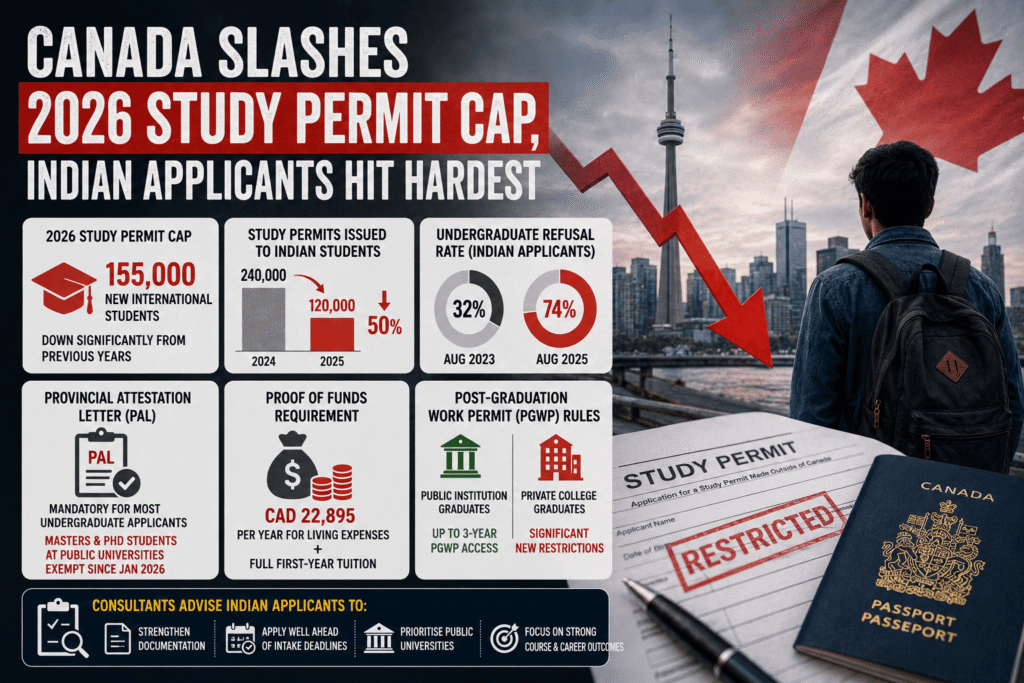
Canada has tightened its international student system for 2026, with the federal government setting a target of 155,000 new international student arrivals under its 2026-2028 Immigration Levels Plan.
The move continues Canada’s effort to reduce temporary resident numbers while maintaining a pathway for international students considered important to the country’s labour market and economy.
For Indian students planning to study in Canada, the environment has become significantly more demanding, with tighter scrutiny, financial requirements and new rules affecting study permits and post-graduation work opportunities.
Canada Sets 155,000 Target for New Student Arrivals in 2026
Under Canada’s 2026-2028 Immigration Levels Plan, the government has set a target of 155,000 new international student arrivals in 2026, down from the previous year’s target.
The target refers to new student arrivals rather than every study permit issued during the year. Canada’s broader 2026 study-permit framework includes different categories, including students who are exempt from the provincial or territorial attestation requirement and existing students applying for extensions.
The government expects the lower intake to help reduce pressure on housing, healthcare and other public services while bringing Canada’s temporary resident population to a more sustainable level.
The permanent residence target, meanwhile, has been stabilised at 380,000 admissions in 2026, the same target set for 2027 and 2028.
Indian Students Face Higher Visa Scrutiny
Indian applicants have faced particularly high study-permit refusal rates during Canada’s recent immigration-policy tightening.
According to Canadian immigration data reported in November 2025, 74% of Indian applications for study permits were refused in August 2025, compared with 32% in August 2023. The figure represented the refusal rate for Indian post-secondary study-permit applications during that month, rather than a full-year 2025 or 2026 rate.
IRCC has attributed the broader increase in refusals to tighter programme-integrity measures and changes to the international student system. Its data showed an overall study-permit refusal rate of 58% between January and August 2025, compared with 48% during the same period in 2024.
The figures underline why applicants now need to pay close attention to their admission documents, financial evidence and overall study plan.
PAL or TAL Required for Most Students
A Provincial Attestation Letter (PAL) or Territorial Attestation Letter (TAL) is generally required when applying for a Canadian study permit, although several categories are exempt.
A major change for 2026 is that, from January 1, 2026, master’s and doctoral students enrolled in degree-granting programmes at public designated learning institutions (DLIs) are exempt from the PAL/TAL requirement.
Other exemptions include primary and secondary school students, certain government-priority groups and some existing study-permit holders applying for an extension at the same institution and level.
The exemption does not mean graduate students automatically receive a study permit. They still need a valid letter of acceptance and must satisfy the other immigration and financial requirements.
Canada Raises Proof-of-Funds Requirement
Financial preparedness has also become an important part of the Canadian study-permit process.
For applications made outside Quebec on or after September 1, 2025, a single student must demonstrate CAD 22,895 for one year of living expenses, excluding tuition and transportation costs. The amount is updated annually.
Applicants must also demonstrate that they have sufficient funds for tuition and transportation.
For programmes lasting longer than one year, applicants must explain how they intend to finance the remainder of their studies. IRCC states that applicants must demonstrate sufficient resources without relying on employment in Canada to fund their studies.
This makes financial documentation particularly important for Indian students applying for the 2026-27 academic year.
PGWP Rules Have Also Tightened
Canada has also changed the Post-Graduation Work Permit (PGWP) system.
Graduating from a Canadian institution does not automatically guarantee a PGWP. Students must graduate from an eligible programme at a PGWP-eligible designated learning institution and satisfy the applicable requirements.
For bachelor’s, master’s and doctoral graduates, IRCC currently requires minimum language proficiency but does not impose a field-of-study requirement. For many other university and college programmes, students whose study-permit application was submitted on or after November 1, 2024 must graduate in an eligible field of study.
PGWP length also depends on the programme and other eligibility conditions. It is therefore inaccurate to state that every graduate of a public institution automatically receives a three-year work permit.
Private College Students Need to Check PGWP Eligibility Carefully
Students considering private colleges need to examine PGWP eligibility before accepting an offer.
IRCC states that programmes delivered by private career colleges under curriculum-licensing arrangements with public institutions are generally not PGWP-eligible, subject to limited grandfathering exceptions for students who began certain programmes before specified dates.
This means the name of the public institution associated with a programme is not, by itself, enough to establish PGWP eligibility.
Students should check the specific institution and programme on Canada’s official DLI and PGWP eligibility information before paying tuition or applying for a study permit.
What Canada’s New Rules Mean for Indian Students
The policy changes do not mean that Canada has stopped accepting international students.
Instead, Canada is moving towards a smaller and more tightly managed international student system.
For Indian applicants, this means the application needs to demonstrate a coherent academic and financial profile. Candidates should ensure that their chosen programme makes sense in light of their previous education and career plans, that their institution and programme meet the relevant immigration requirements, and that their financial documents are complete and credible.
Applicants should also avoid relying on old advice about Canada’s student visa system because several important requirements have changed since 2024.
Documents and Eligibility Need Greater Attention
Before applying, students should verify:
- Letter of Acceptance from a designated learning institution
- PAL/TAL requirement or applicable exemption
- Proof of funds
- Tuition and living-cost evidence
- Academic qualifications
- Language requirements
- Study-plan and admissibility requirements
- PGWP eligibility of the specific programme
- Whether the programme is subject to a field-of-study requirement
- Provincial requirements, including Quebec-specific rules where applicable
IRCC also requires applicants to demonstrate that they meet the requirements of Canada’s immigration legislation and, among other things, that they will leave Canada at the end of their authorised stay unless they have another lawful basis to remain.
Canada Study Permit 2026: A More Selective Environment
Canada remains an option for international students, but the policy environment in 2026 is substantially more restrictive than it was several years ago.
The 155,000 new student-arrival target, tighter programme controls, PAL/TAL system, higher financial requirements and changes to PGWP eligibility all mean that prospective students need to evaluate their institution and programme more carefully.
For Indian students in particular, the 74% refusal rate recorded in August 2025 demonstrates the level of scrutiny that existed during Canada’s immigration-policy tightening, although that monthly figure should not be treated as a prediction of an individual applicant’s chances in 2026.
The safest approach is to rely on current IRCC rules, verify the eligibility of the specific programme and institution, and prepare a complete application rather than relying on outdated assumptions about studying and working in Canada.