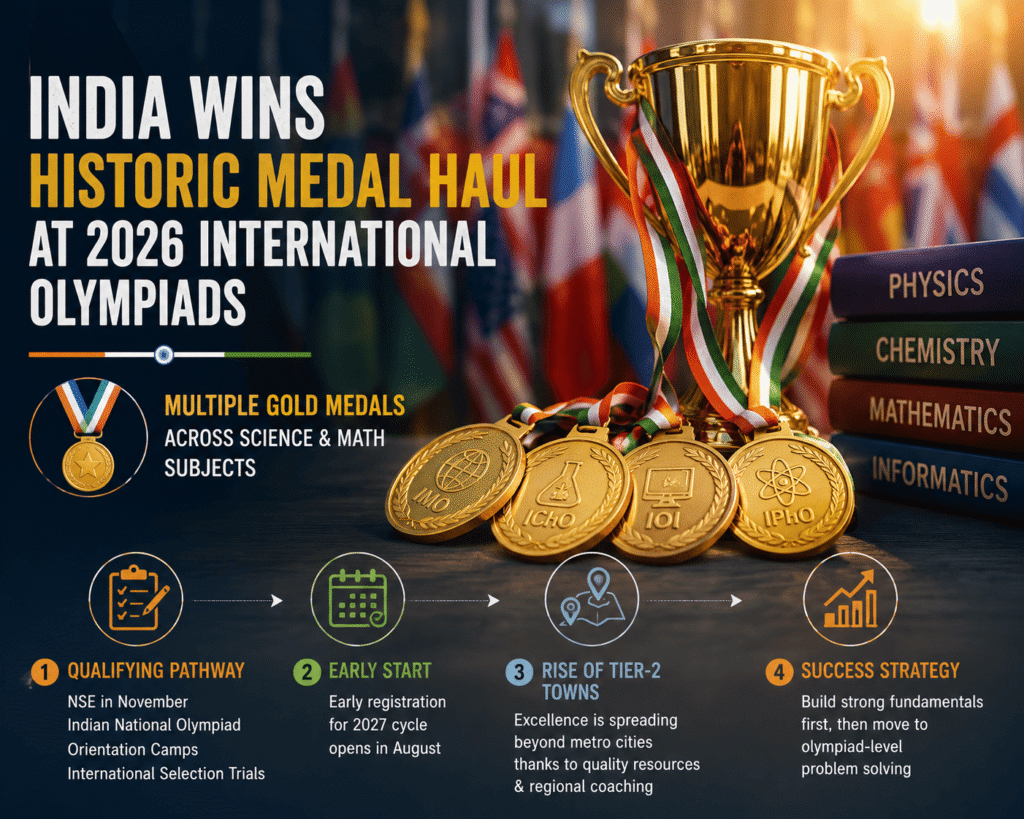
Indian students have delivered one of the country’s strongest performances at the 2026 International Olympiads, winning 12 gold and 7 silver medals across Physics, Chemistry, Biology and Mathematics.
The performance included historic all-gold results in both Physics and Chemistry. The Department of Atomic Energy described the 2026 results as one of India’s finest-ever performances at the International Olympiads.
India Records Historic Gold Sweeps in Physics and Chemistry
India’s strongest results came in Physics and Chemistry.
At the 56th International Physics Olympiad (IPhO) 2026, all five members of the Indian team won gold medals. India finished joint first in the country rankings alongside China, Kazakhstan, Russia, South Korea and Taiwan. The competition was held in Bucaramanga, Colombia, from July 5 to July 12.
The Indian Physics Olympiad team comprised:
- Kanishk Jain
- Riddhesh Anant Bendale
- Rishit Garg
- Shresth Suraiya
- Svarit Joshi
All five students received gold medals.
India also achieved a historic result at the International Chemistry Olympiad (IChO) 2026, where all four Indian participants won gold medals. This was India’s first all-gold performance at the International Chemistry Olympiad.
India Wins Two Golds at International Mathematical Olympiad
At the 67th International Mathematical Olympiad (IMO) 2026, held in Shanghai, China, India won two gold and four silver medals.
The Indian gold medallists were Aarav Gupta from Delhi and Abel George Mathew from Karnataka. Bairav Murugan, Kanav Talwar, Sanjana Philo Chacko and Shreya Shantanu Mundhada won silver medals.
India’s six-member team therefore earned a medal in every individual position at the 2026 IMO.
India Wins Four Medals in Biology
India’s performance also extended to the International Biology Olympiad (IBO) 2026.
The Indian team won one gold and three silver medals, taking India’s overall medal tally across the four major Olympiads to 19 medals.
The Biology result demonstrates that India’s strong performance was not limited to mathematics and physical sciences.
India’s Overall 2026 Olympiad Medal Tally
According to the Department of Atomic Energy, India’s results across the four Olympiads were:
| Olympiad | Gold | Silver | Overall result |
|---|---|---|---|
| International Physics Olympiad | 5 | 0 | Joint World No. 1 |
| International Chemistry Olympiad | 4 | 0 | Joint World No. 1 |
| International Biology Olympiad | 1 | 3 | 4 medals |
| International Mathematical Olympiad | 2 | 4 | 6 medals |
| Total | 12 | 7 | 19 medals |
The figures make 2026 a particularly strong year for India’s international Olympiad programme.
How Indian Students Reach the International Olympiads
Students aiming for future International Olympiad teams need to go through subject-specific national selection programmes.
For Physics, Chemistry, Biology and Astronomy, the first stage is the National Standard Examination (NSE). The NSEs are generally held towards the end of November, and high-performing students progress to the Indian National Olympiads before entering the later selection and training stages.
The mathematics pathway is different.
For the International Mathematical Olympiad, students first appear for the Indian Olympiad Qualifier in Mathematics (IOQM), followed by the Regional Mathematical Olympiad (RMO) and then the Indian National Mathematical Olympiad (INMO).
For the 2026-27 mathematics cycle, HBCSE has scheduled RMO 2026 for November 15, 2026, followed by INMO 2026 on January 17, 2027.
Why Olympiad Preparation Is Different From School Exams
International Olympiads test a level of problem-solving that goes beyond conventional school examinations.
HBCSE notes that although the science Olympiad syllabus is broadly aligned with the CBSE curriculum, questions can be substantially more difficult than board-level examinations.
Students therefore need more than textbook familiarity. Successful preparation generally involves:
- Strong fundamentals in the relevant school subjects
- Regular practice with unfamiliar problems
- Development of mathematical and scientific reasoning
- Learning to construct rigorous solutions
- Exposure to previous Olympiad problems
- Timed examination practice
- Progressive preparation rather than last-minute study
Students should first build a strong foundation in their school curriculum before moving towards specialised Olympiad-level problems.
Olympiad Success Is Not Limited to One Type of School
The 2026 results also feature students from different parts of India and different school backgrounds.
The Mathematics team, for example, included students from Delhi, Karnataka, Kerala and Maharashtra. The Indian Informatics Olympiad also recorded gold-medal winners from cities including Jaipur, Chandigarh, Delhi, Bengaluru, Ahmedabad, Mohali, Malda and Patiala.
These results show that high-level Olympiad talent is being identified across multiple regions, although the available results alone do not establish that smaller cities are now outperforming metropolitan coaching centres.
How Students Can Prepare for the 2027 Olympiad Cycle
Students targeting the next cycle should first identify the Olympiad corresponding to their subject.
For science Olympiads, candidates should monitor the NSE registration and examination schedule and check the official eligibility requirements before registering. HBCSE states that NSE registration can be completed through eligible schools or designated centres.
Mathematics aspirants should instead follow the IOQM-RMO-INMO pathway and monitor announcements from HBCSE and the Mathematics Teachers’ Association.
Preparation should begin with fundamentals rather than immediately attempting the hardest international problems.
A student who has mastered the school-level concepts can gradually move towards Olympiad problem sets, previous national-level papers and eventually international-level problems.
India’s 2026 Olympiad Performance
India’s 12 gold and 7 silver medals at the 2026 International Olympiads represent a significant achievement for the country’s school-level mathematics and science ecosystem.
The five-gold Physics sweep and four-gold Chemistry sweep were particularly notable, while the Mathematics and Biology teams also produced strong medal-winning performances.
For students looking towards the 2027 cycle, the results provide both an example of the level required to compete internationally and a reminder that Olympiad preparation is a long-term process built on fundamentals, problem-solving ability and sustained practice.