Artificial intelligence is transforming how people work, communicate, create and solve problems. From generative AI tools and autonomous systems to healthcare, finance and scientific research, AI is becoming part of an increasingly digital world.
But behind every AI model is physical infrastructure.
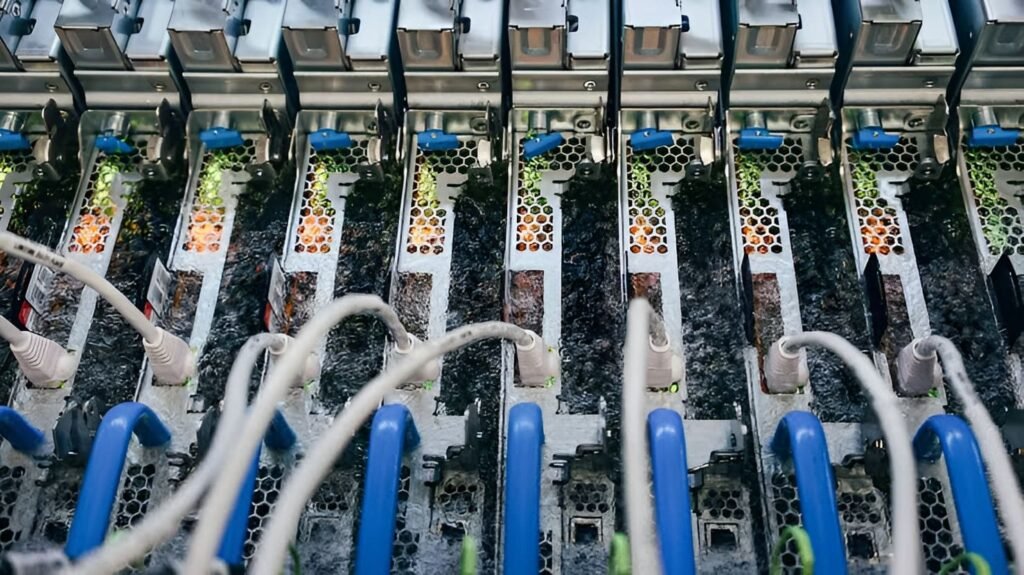
AI systems require powerful computer chips, servers and data centers to train models and process requests. As AI adoption grows, so does the demand for the electricity, water, hardware and infrastructure needed to keep these systems running.
This raises an important question: What is the environmental impact of AI data centers, and how can the industry grow without putting unnecessary pressure on natural resources?
The Growing Energy Demand of AI Data Centers
Data centers are facilities filled with servers and other equipment that process, store and transmit digital information. AI workloads can require particularly powerful computing hardware, increasing the amount of electricity needed.
According to the International Energy Agency (IEA), global data center electricity consumption was around 415 terawatt-hours (TWh) in 2024, representing about 1.5% of global electricity consumption. The IEA’s base-case projection suggests this could roughly double to around 945 TWh by 2030.
AI is an important driver behind this growth. Advanced AI servers use high-performance processors that can consume considerably more power than conventional computing equipment.
The challenge is not simply how much electricity AI uses, but where that electricity comes from. If additional demand is supplied by carbon-intensive power generation, the associated emissions can increase.
How AI Data Centers Affect Water Resources
Electricity is not the only resource required by data centers. Water can also play an important role in cooling computing equipment.
Servers generate substantial heat, particularly when operating intensive AI workloads. Depending on the cooling technology and location, data centers may use water directly for cooling or indirectly through the water requirements associated with electricity generation and semiconductor manufacturing.
The IEA estimates that global data center water consumption could increase from approximately 560 billion litres per year currently to around 1.2 trillion litres by 2030 in its base case.
However, water use varies significantly between facilities. Climate, cooling technology, electricity sources and local infrastructure all influence the amount of water required.
This makes location and cooling design important considerations when developing new AI data centers, particularly in regions where water resources are already under pressure.
AI’s Carbon Footprint
The environmental impact of AI is also connected to carbon emissions.
Data centers themselves do not necessarily produce large amounts of carbon directly. Much of their carbon footprint depends on the electricity used to operate them and how that electricity is generated.
The IEA estimates that data centers currently account for around 0.5% of global combustion-related CO₂ emissions, although their emissions are expected to increase as electricity consumption grows.
At the same time, AI’s environmental footprint is difficult to calculate precisely. Different AI models, hardware, data centers, electricity grids and cooling systems can produce very different results.
That is why broad claims about the environmental cost of “one AI query” should be treated carefully.
The Hidden Environmental Cost of AI Hardware
There is another part of the AI environmental equation: hardware manufacturing.
AI data centers require GPUs, CPUs, memory, networking equipment, servers and other components. Producing these technologies requires raw materials, energy and water.
Semiconductor manufacturing, in particular, relies on highly controlled production environments and ultra-pure water.
As AI infrastructure expands, responsible technology development therefore needs to consider the complete lifecycle of hardware—from manufacturing and transportation to operation, upgrades and eventual recycling.
Is AI Bad for the Environment?
The answer is more complicated than a simple yes or no.
AI increases demand for computing infrastructure and can therefore increase electricity consumption, water use and emissions. However, AI can also be used to reduce resource consumption in other industries.
For example, AI can help energy companies forecast electricity demand, identify equipment problems, optimize power generation and improve the efficiency of complex energy systems.
The IEA notes that widespread adoption of existing AI applications in the electricity sector could potentially produce significant economic and efficiency benefits, including improved use of transmission infrastructure.
AI can also support areas such as climate modeling, renewable-energy forecasting, industrial optimization and detection of methane leaks.
Therefore, the environmental impact of AI depends not only on how much computing we use, but also on what we use it for and how efficiently the infrastructure is operated.
1. Using Renewable Energy
Powering data centers with low-carbon electricity can reduce emissions associated with their operation. Solar, wind, nuclear and other low-carbon energy sources can all play a role depending on local conditions and grid availability.
2. Improving Cooling Efficiency
Better cooling systems can reduce both electricity and water requirements. Some newer approaches focus on closed-loop or alternative cooling technologies that can reduce reliance on continuously consumed water.
3. More Efficient AI Hardware
More efficient chips and servers can allow AI models to perform more work using less electricity. Improvements in hardware and software efficiency are particularly important as AI adoption continues to expand.
4. Smarter Data Center Locations
Building facilities in areas with cleaner electricity, suitable climates and sufficient water resources can help reduce environmental pressure.
5. Better Environmental Reporting
Greater transparency about electricity consumption, water use, emissions and hardware lifecycle impacts would make it easier for businesses, policymakers and consumers to understand AI’s real environmental footprint.
The Future of AI Must Also Be Sustainable
AI is likely to remain one of the most important technologies of the coming decade. Its benefits could extend across healthcare, education, science, manufacturing, energy and many other industries.
But technological progress comes with physical requirements.
The growth of AI data centers means society must think beyond computing power and model performance. Energy efficiency, water management, renewable electricity, responsible hardware production and transparent environmental reporting need to become part of the AI conversation.
The goal should not necessarily be to stop AI development. Instead, the challenge is to build an AI ecosystem that can deliver technological progress while using resources more responsibly.
Ultimately, the future of AI will depend not only on how intelligent our machines become, but also on how sustainably we build and power them.