
What happens when AI stops simply answering questions and starts doing the work itself?
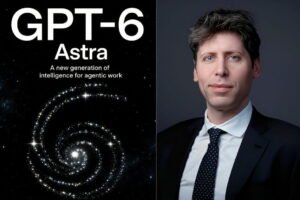
That question has become harder to ignore following the arrival of GPT-6 Astra, OpenAI’s latest flagship AI model. Astra is designed for advanced reasoning, computer use, software engineering, cybersecurity, science and professional work. OpenAI describes it as its most capable model yet.
But the biggest story is not how intelligent Astra is.
It is what happens when intelligence becomes automated, scalable and available to businesses.
From office workers and programmers to researchers and customer-service teams, AI is beginning to challenge something humans have considered uniquely ours for centuries: intellectual work.
GPT-6 Astra Is Not Just Another Chatbot
Earlier AI tools generally required humans to give instructions, review the response and move between different applications.
Astra is designed to go much further.
It can work with computers, browse information, write software, conduct research and perform complex professional tasks. That means AI is increasingly moving from being a tool humans operate to an agent that can complete parts of a job independently.
That difference could have enormous consequences.
Which Jobs Are Most at Risk?

Not every job is equally vulnerable.
Jobs are particularly exposed when they involve repetitive digital tasks, predictable workflows and large amounts of information processing.
Jobs facing greater AI pressure
- Data entry and basic data processing
- Customer-support and chat operations
- Administrative and back-office work
- Basic content writing and editing
- Routine translation
- Entry-level programming
- Basic graphic and design production
- Research and information gathering
- Bookkeeping and routine financial analysis
- Standardized marketing tasks
The danger is not necessarily that these professions disappear overnight.
Instead, fewer people may be required to perform the same amount of work.
A company that previously needed ten employees to handle a particular digital workflow might eventually need five people supervising AI systems.
That could make entry-level employment particularly challenging because many young workers traditionally enter industries by performing exactly these repetitive tasks.
Which Jobs Are More Difficult to Replace?
Jobs that depend heavily on physical presence, human relationships, judgment, responsibility and unpredictable real-world situations are generally harder to automate completely.
These include:
- Nurses and many healthcare professionals
- Skilled tradespeople
- Electricians and plumbers
- Teachers and educators
- Emergency responders
- Therapists and counsellors
- Skilled technicians
- Construction workers
- Leadership and negotiation roles
- Jobs requiring complex interpersonal relationships
This does not mean these professions are immune to AI.
Teachers may use AI for lesson planning. Doctors may use it for research. Engineers may use it for design. Even tradespeople may eventually use AI-powered tools.
The difference is that AI is more likely to assist the human rather than completely replace the human.
The Biggest Consequence: Humans Are Being Challenged

The most uncomfortable part of the AI revolution is not job loss.
It is the possibility that humans may no longer be the fastest or most efficient option for many intellectual tasks.
For generations, education has trained people to read, write, calculate, research, analyse information and solve problems.
Now machines can increasingly perform many of those activities.
OpenAI says Astra reaches extremely high performance on several demanding benchmarks, including a reported 99.9% on ARC-AGI-3 and 98% on FrontierMath Tier 4.
This creates a fundamental question:
If machines can perform many tasks faster, cheaper and at enormous scale, what should humans focus on?
The answer may increasingly be judgment, creativity, communication, leadership, ethics and the ability to decide what should be done, rather than simply knowing how to do it.
The Business World Could Change First
For businesses, GPT-6 Astra could be incredibly attractive.
Companies can potentially automate research, software development, documentation, customer operations and other knowledge-intensive processes.
OpenAI has already published examples of companies using Astra to reduce manual work. Playco, for example, reported 50% fewer manual fixes while prototyping games with Astra.
For businesses, that means higher productivity.
For employees, however, the same productivity improvement can create uncertainty.
If AI allows one employee to accomplish what previously required several employees, companies may reconsider hiring, team sizes and operating costs.
And Then There Is the Cybersecurity Problem
Astra’s capabilities are not limited to ordinary office work.
OpenAI’s safety documentation says GPT-6 Astra is its first model to reach the Critical level of cybersecurity capability under its Preparedness Framework. The model can identify previously unknown security weaknesses under certain conditions.
That creates a strange paradox.
The same technology that can help cybersecurity professionals defend systems could also make sophisticated attacks more accessible.
This is one reason AI safety has become such an important part of the discussion surrounding frontier models.
Could Humans Become Too Dependent on AI?
There is another danger that receives less attention: dependency.
Imagine a generation that rarely writes without AI, researches without AI or solves difficult problems without AI assistance.
Productivity could increase—but some human skills could weaken through lack of practice.
The question is no longer simply:
“Can AI do this?”
It is becoming:
“Should humans stop doing this simply because AI can?”
That distinction could determine how society adapts.
Is This the Beginning of the End for Humans?
Probably not.
But it could be the beginning of the end for the idea that humans must always be the most capable workers in every intellectual field.
GPT-6 Astra represents a significant technological shift, but it is still a technology created, deployed and controlled within human institutions. Its future impact will depend on regulation, business decisions, education, safety measures and how much authority people give AI systems.
The real competition may therefore not be humans versus AI.
It may be humans who learn to work with AI versus humans who refuse to adapt.
AI does not necessarily have to replace humanity.
But it is already forcing humanity to rethink what makes human work valuable.
And that may be the biggest challenge GPT-6 Astra brings—not that machines are becoming more human, but that humans are being forced to redefine what only humans can do.