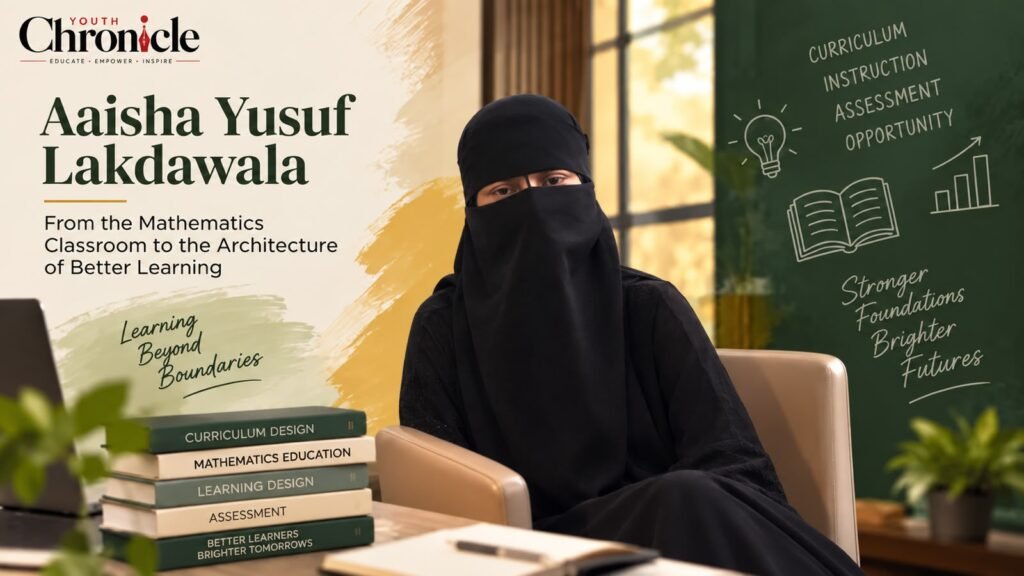
For Aaisha Yusuf Lakdawala, education was never simply about knowing the right answer. Her professional journey has been shaped by a more fundamental question: what makes learning actually work?
That question has taken her well beyond the traditional boundaries of classroom teaching. Over more than 11 years, Lakdawala has built experience across mathematics education, curriculum design, instructional design, assessment development, content development, editorial review, and academic quality assurance. Today, she works as an independent K-12 education and learning-design professional, bringing together roles as a Senior Instructional Designer, Curriculum and Standards Specialist, Mathematics SME, and Editorial and Quality Assurance professional.
Her career represents a gradual expansion of perspective. It began with teaching mathematics across primary, middle school, secondary, and higher-secondary levels. It then moved into the design of educational resources, where the challenge was no longer only to explain mathematics to students, but to understand how curriculum standards, learning objectives, instruction, practice, assessment, and quality assurance could work together.
Where the Journey Began: Learning Inside the Classroom
Lakdawala’s professional foundation was built in the classroom. Her experience teaching mathematics across different stages of K-12 education gave her a direct view of how students learn, where they struggle, and how instructional choices can influence learning outcomes. That experience would eventually become one of the defining strengths of her career.
Her academic background also spans multiple qualifications, including a B.Ed. in Mathematics and Economics, a Bachelor’s degree in Commerce, a D.Ed., and an ECCED qualification. Together with her teaching experience, these qualifications provided the foundation for a career that increasingly connected subject expertise with the broader design of learning.
The transition from classroom teaching did not represent a departure from education. Instead, it expanded the scale at which she could contribute. She became interested in the way concepts are sequenced, explained, represented, practised, and assessed, recognising that subject knowledge is only one component of effective learning.
The Shift From Teaching to Learning Design
A significant turning point came when Lakdawala moved from primarily working as a classroom mathematics educator into broader curriculum, assessment, and instructional-design roles. This allowed her classroom experience to inform the development and quality of learning resources that could potentially serve much larger numbers of students and educators.
Over the course of this transition, she worked with organisations including LearningMate, Innovalance Learning Solutions, PhysicsWallah, HarperCollins India, and QBS Learning. Her responsibilities have included curriculum mapping, standards alignment, assessment design and review, instructional storyboarding, content development, editorial QA, accessibility, and collaboration with subject-matter experts and cross-functional teams.
The breadth of this work has also exposed her to both Indian and international curricula. Her experience includes Common Core and multiple US state standards, as well as CBSE, ICSE, Cambridge, and GCSE. Working across these frameworks has required an understanding not only of what students are expected to learn, but also of how curriculum expectations translate into usable educational content.
Identifying the Gap Between Curriculum, Content and Assessment
One recurring issue Lakdawala identified in education is the disconnect between curriculum expectations, instructional content, and assessment. A resource can address the correct topic and still fail to meet the intended depth, prerequisite knowledge, cognitive demand, or assessment expectations.
Her professional focus has therefore been on creating greater alignment across the learning journey. Rather than treating curriculum standards, learning objectives, instruction, practice, assessment, and quality assurance as separate components, she works toward resources in which these elements are intentionally connected.
That approach is central to her current professional offering. Her work includes K-12 curriculum and learning-design services, curriculum mapping and standards alignment, mathematics content development, instructional design, assessment development and review, editorial and academic QA, learning-resource development, accessibility support, and AI-assisted curriculum workflows.
Bringing Multiple Education Disciplines Together
The distinction in Lakdawala’s approach lies in the combination of disciplines she brings to a single educational resource. Subject expertise, curriculum understanding, instructional design, assessment, and quality assurance are often handled by different specialists. Her experience allows her to examine these dimensions together.
That means evaluating whether the mathematics is correct, whether curriculum expectations have been met, whether a learning progression makes sense, whether an assessment measures the intended skill, and whether the final resource is clear and usable. Her classroom background provides the learner perspective, while her later professional experience adds the curriculum and production perspective.
This combination has shaped the audience she serves. Her work primarily supports K-12 learners, educators, curriculum teams, education companies, publishers, and learning-design teams, particularly those developing mathematics and broader educational resources for US and Indian curricula.
Maintaining Quality Across Curricula and Stakeholders
Working across multiple curricula, grade levels, stakeholders, and quality expectations presents a practical challenge: maintaining consistency and academic accuracy while dealing with different requirements. Lakdawala has approached this challenge through structured processes rather than relying on individual review alone.
Her methods include curriculum mapping, crosswalks, review frameworks, documented quality-assurance processes, collaboration with subject-matter experts and stakeholders, and multiple validation stages. She has also incorporated technology and AI-assisted workflows where they can improve efficiency while retaining academic judgment.
Her use of AI is therefore an addition to her existing expertise rather than replacement. More recently, she has used AI-assisted tools in areas such as curriculum analysis, content development, standards verification, and learning-design workflows.
Recognition Built Alongside Continuous Learning
Lakdawala’s career has also included professional recognitions, certifications, and contributions to educational content. The submitted profile lists a Teacher Innovation Award from the Sri Aurobindo Society, Innovation in Education, IV National Launchpad, Generative AI for Educators, Google AI for Educators, AIE NEP 2020 Teacher Certification, and Mathematics Examiner Certification. It also identifies her as a co-author of Critical Thinking and Problem Solving and notes SME and academic content-development certifications through HarperCollins and QBS Learning.
For Lakdawala, however, professional growth appears less connected to a single milestone than to the cumulative development of capabilities across disciplines. She describes her career as one that connects teaching, mathematics expertise, curriculum design, assessment, instructional design, quality assurance, and AI-supported learning.
That progression has allowed her to move from understanding learning primarily through direct classroom interaction to examining the systems and resources through which learning is designed and delivered.
Building the Next Phase of Education and Learning Design
Looking ahead, Lakdawala intends to continue working at the intersection of curriculum design, instructional design, assessment, educational technology, and AI-supported learning. Over the next five years, she aims to contribute to larger-scale learning products and curriculum initiatives while continuing to develop innovative, evidence-informed learning experiences for K-12 and potentially broader professional learning audiences.
Her larger vision is centred on treating learning resources with the same level of care given to the curriculum itself. For her, accuracy, alignment, learner experience, accessibility, assessment, and engagement need to operate together rather than independently. The ultimate objective is to create learning experiences that help learners understand and apply knowledge, think critically, and become more confident learners.
This also explains why continuous learning remains central to her professional identity. Her own career has evolved alongside changes in education, from classroom teaching and mathematics to curriculum, assessment, instructional design, quality assurance, educational technology, and AI. She sees that evolution as ongoing rather than complete.
A Career Defined by the Connections Between Disciplines
Lakdawala is one such story in society which shows how value can be created in others life. Her journey did not follow a single job title from beginning to end. Instead, each stage added another layer to the way she understands learning.
Her advice to young professionals reflects that experience. She encourages people not to restrict themselves to one job title or one definition of expertise, but to learn across disciplines and understand how different skills connect. Her own path, from classroom teaching to content development, assessment, curriculum, instructional design, QA, and AI-supported learning, illustrates the value of building on existing expertise while continuing to expand it.
The central thread running through that journey is straightforward: educational content should do more than contain correct information. It should be thoughtfully designed around the learner, aligned with what needs to be learned, appropriately assessed, accessible, and capable of supporting genuine understanding.
Conclusion
Aaisha Yusuf Lakdawala’s professional journey is a story of moving progressively closer to the architecture of learning itself. From teaching mathematics in the classroom to working across curriculum, assessment, instructional design, editorial quality, accessibility, and AI-supported workflows, she has expanded the scope of her contribution without losing sight of the learner at the centre.
Her next chapter continues in that same direction. By combining mathematics expertise with curriculum knowledge, learning design, assessment, quality assurance, and emerging technology, Lakdawala is positioning her work around a practical question that has guided her career from the beginning: how can educational resources be designed to help people learn better?
Connect with Aaisha Yusuf Lakdawala:
LinkedIn Profile