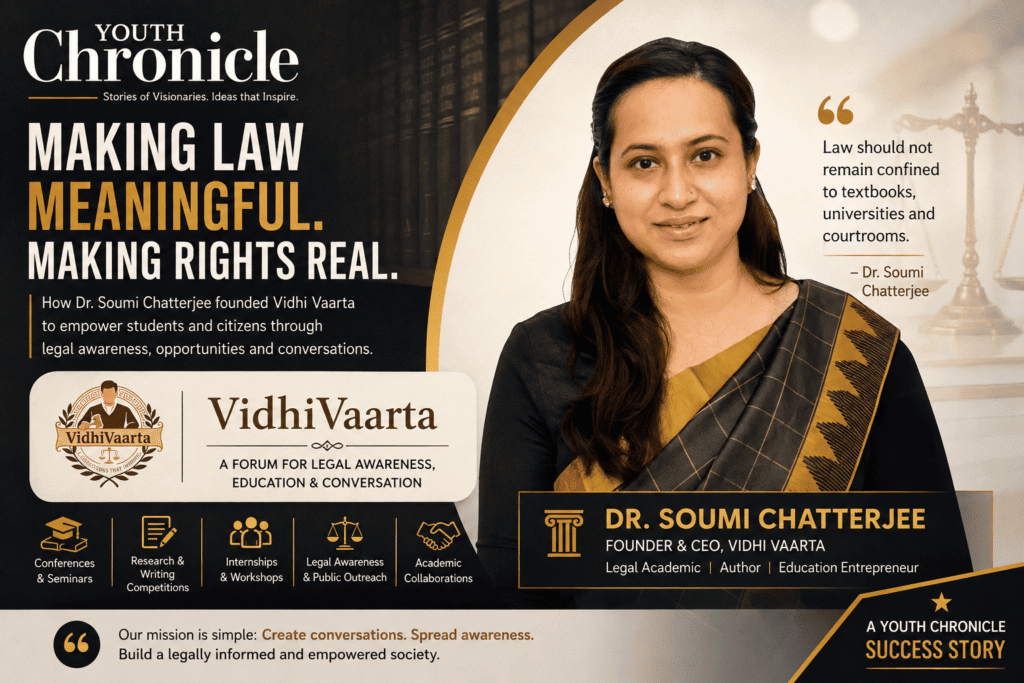
Law affects almost every stage of a person’s life, from employment and property to marriage, consumer transactions and interactions with public institutions. Yet understanding legal rights and responsibilities can remain difficult for people without formal legal education.
Dr. Soumi Chatterjee, founder and CEO of Vidhi Vaarta, is working to narrow that gap by creating spaces where students, academics, legal professionals and citizens can engage with law through conferences, internships, competitions, expert discussions and other learning initiatives.
Founded as a forum for spreading awareness about legal rights, duties and government schemes, Vidhi Vaarta has developed into a legal education and awareness platform with a growing academic community. Independent listings of its programs identify Dr. Soumi Chatterjee as its Founder/Director or Founder/CEO alongside co-founders Mohammad Raashid Ali, Mohammad Taasir Ali and Divyanshu Nautiyal.
At the centre of the initiative is a straightforward idea: law should not remain confined to textbooks, universities and courtrooms.
Who Is Dr. Soumi Chatterjee?
Dr. Soumi Chatterjee is a legal academic, author and founder/CEO of SRTD Group and Vidhi Vaarta, a platform focused on legal education, research and awareness.
Her academic background includes legal studies at Rajiv Gandhi National University of Law, Patiala, while her professional and research journey has extended across teaching, writing and legal scholarship. Her public professional profile identifies her as Founder/CEO of SRTD Group, including Vidhi Vaarta and The ConvoSane Show.
Her published research has addressed subjects including domestic violence, gender-neutral laws, intimate partner violence, sexual harassment of men, forensic science and anti-dowry legislation.
She is also the author of “Dowry: Laws and Its Misuse in India,” published in 2021, and has received recognition for her work as an author.
This combination of legal scholarship and education eventually became an important foundation for Vidhi Vaarta.
The Idea Behind Vidhi Vaarta
The concept behind Vidhi Vaarta emerged from Dr. Soumi Chatterjee’s observation of two different but connected problems.
The first involved law students.
She observed that many students needed greater exposure to practical opportunities, academic networks and environments where they could actively participate rather than simply study legal theory.
The second involved the general public.
People are governed by laws and legal systems throughout their lives, but many do not have a clear understanding of their basic rights, responsibilities or available legal mechanisms.
“There were two things I kept noticing: Students, especially from private universities, lacked motivation and opportunities. And the general public remained unaware of their basic legal rights,” Dr. Chatterjee explains.
Vidhi Vaarta was developed as a platform capable of addressing both groups through conversation, participation and practical learning.
What Is Vidhi Vaarta?
Vidhi Vaarta is a legal awareness and education forum founded by Dr. Soumi Chatterjee to spread knowledge about legal rights, duties, government schemes and contemporary legal issues through educational and academic activities.
External listings of Vidhi Vaarta’s competitions describe the organization as a forum created to spread awareness and knowledge through seminars, conferences and related initiatives concerning legal rights, duties and government schemes.
The organization was constituted by:
- Dr. Soumi Chatterjee, Founder/Director
- Mohammad Raashid Ali, Co-Founder
- Mohammad Taasir Ali, Co-Founder
- Divyanshu Nautiyal, Co-Founder
Its activities have expanded into research competitions, conferences, internships, expert talks and legal simulations.
The name itself reflects the philosophy behind the initiative.
“Vidhi” refers to law, while “Vaarta” refers to conversation or dialogue.
The objective is therefore not merely to teach legal rules, but to encourage discussion around them.
Making Legal Education More Practical
Traditional legal education provides students with doctrinal knowledge, statutes, judgments and legal principles.
But becoming an effective legal professional also requires research, drafting, advocacy, communication, networking and practical exposure.
Vidhi Vaarta attempts to complement formal legal education through experiential opportunities.
Its initiatives have included:
- Conferences and seminars
- Research and article-writing competitions
- Virtual internships
- Expert talks
- Workshops
- Legal simulations
- Moot court activities
- Academic collaborations
This practical orientation is particularly relevant for students who may have limited access to professional networks or extracurricular opportunities through their institutions.
Vidhi Vaarta’s International Conference on Religion and Law
One of the organization’s significant early academic initiatives was the International Virtual Conference on “Religion and Law in Transnational Diaspora,” held on April 26 and 27, 2025.
The conference created opportunities for academic presentations and research publication while bringing together participants interested in the relationship between law, religion and transnational communities.
The program included paper-presentation awards, publication opportunities and internships for selected participants.
For Dr. Soumi Chatterjee, the conference represented an important validation of Vidhi Vaarta’s academic model.
“The event exceeded all expectations,” she recalled. “It was more than just a milestone; it was a validation of our efforts.”
Research and Writing Opportunities Through Vidhi Vaarta
Legal research and writing form another important part of Vidhi Vaarta’s activities.
The platform has organized competitions addressing contemporary and sometimes under-discussed legal questions.
One such initiative was the Research Writing Competition 2025 on “Advancing Men’s Rights: Challenges, Opportunities & Future Directions.” The competition offered publication opportunities and an internship for the top research-paper writer.
Vidhi Vaarta has also organized the Late Janaki Ballabh Memorial Essay Writing Competition on Law, Language and Culture.
The original account of the organization’s activities additionally identifies writing initiatives addressing subjects such as medical negligence, men’s rights and the relationship between language, culture and law.
Such programs encourage students to engage with law as researchers rather than simply examination candidates.
Creating Internship Opportunities for Law Students
Internships are particularly important in legal education because students need exposure to how legal research, drafting and professional work operate outside classrooms.
Vidhi Vaarta has incorporated internships into its broader student-development model.
The platform’s current activity shows that this area has continued to develop.
In 2026, Vidhi Vaarta concluded a Virtual Summer Internship Program in association with the Faculty of Law, ICFAI University, Tripura.
This demonstrates that the initiative has continued beyond its initial 2024-25 activities and has begun developing institutional collaborations around legal training.
From Legal Theory to Legal Simulation
Another evolution in Vidhi Vaarta’s work has been the development of legal simulation and advocacy-oriented activities.
The organization established the Centre for Legal Simulations and Research, which has been associated with moot court and arbitration-related initiatives.
Materials relating to the Vidhi Vaarta Arbitration Moot 2025 identify the Centre for Legal Simulations and Research and describe its objective as providing innovative legal training and holistic development opportunities for aspiring legal professionals.
This represents a practical extension of the platform’s original philosophy.
Students do not only discuss legal principles.
They can also practise how those principles operate in simulated professional environments.
Why Legal Awareness Matters Beyond Law Schools
Vidhi Vaarta’s mission extends beyond law students.
Dr. Soumi Chatterjee has consistently framed legal awareness as something relevant to ordinary citizens.
A person does not need to become an advocate to benefit from understanding the law.
Knowledge of legal rights can influence decisions involving employment, family relationships, contracts, property, consumer disputes and interactions with institutions.
This is why Dr. Chatterjee describes her objective in broader terms:
“I wanted to take law out of ivory towers and bring it to the people.”
The statement captures the central philosophy behind Vidhi Vaarta.
Legal education should not only produce lawyers.
Legal awareness should also produce better-informed citizens.
Addressing the Gap Between Legal Curriculum and Practical Exposure
One of the challenges identified by Dr. Chatterjee is the difference between studying law and experiencing its practical dimensions.
India has a large legal education ecosystem, but access to opportunities can vary significantly between institutions and students.
Networking can also become a barrier.
“Building our name in the academic circuit was slow,” Dr. Chatterjee recalls. “Networking was difficult, and students from private universities often didn’t engage the way we hoped.”
Rather than abandoning the model, the Vidhi Vaarta team increased its emphasis on experiential formats.
Competitions, internships, boot camps and collaborations became tools for encouraging participation.
Dr. Soumi Chatterjee’s Research and Academic Work
Dr. Soumi Chatterjee’s own research interests help explain why Vidhi Vaarta addresses subjects that may not always receive mainstream attention.
Her publication record includes work on:
- Misuse of anti-dowry laws
- Domestic violence
- Gender-neutral legislation
- Intimate partner violence
- Sexual harassment of men
- Forensic science and sexual violence
- Women’s education and empowerment
Her doctoral research examined the alleged misuse of anti-dowry laws against husbands and in-laws, while her book “Dowry: Laws and Its Misuse in India” further explored the subject.
Her work therefore frequently engages with legally and socially contested questions rather than avoiding them.
That approach is also visible in Vidhi Vaarta’s choice of research themes.
Vidhi Vaarta’s Growing Legal Community
Vidhi Vaarta has also developed a visible professional community online.
Its current LinkedIn presence has approximately 4,000 followers and describes the platform as dedicated to advancing legal awareness.
Recent activity indicates continued involvement in legal internships, academic partnerships, conferences, research opportunities and student leadership programs.
The platform has also participated as a media partner for legal and interdisciplinary conferences, extending its network across academic institutions and professional communities.
This continuing activity is significant because Vidhi Vaarta was launched only in 2024.
Vidhi Vaarta and the SRTD Group
Vidhi Vaarta forms part of a broader ecosystem developed under the SRTD Group.
Dr. Soumi Chatterjee’s professional profile identifies her as Founder/CEO of SRTD Group, with Vidhi Vaarta and The ConvoSane Show among its initiatives.
The original vision of SRTD was built around the idea “Where Education Meets Adventure.”
Rather than treating education as something restricted to classrooms, the group explores different formats for learning, conversation and experience.
This broader structure has included Vidhi Vaarta for legal education, The ConvoSane Show for discussions and Gang of Travellers for travel-oriented experiential activities.
The ConvoSane Show
The original SRTD roadmap also included The ConvoSane Show, conceived as a virtual podcast series exploring subjects beyond law.
Topics proposed for the series included entrepreneurship, spirituality, fertility, lifestyle and parapsychology.
The concept reflects the broader intellectual approach behind the SRTD ecosystem.
Vidhi Vaarta focuses specifically on law.
The wider group attempts to create conversations around different areas of knowledge and human experience.
Gang of Travellers and Experiential Learning
Another SRTD initiative identified in the original profile is Gang of Travellers, which combines travel with experiential learning.
Activities reported under the initiative included trips to:
- Jim Corbett National Park
- Tungnath Mahadev
- Deoriatal Lake
Although this initiative operates outside legal education, it illustrates Dr. Chatterjee’s broader educational philosophy.
Learning does not necessarily need to occur through formal lectures.
Experience, exploration and conversation can also become educational tools.
The Team Behind Vidhi Vaarta
While Dr. Soumi Chatterjee leads the initiative, Vidhi Vaarta was constituted as a collaborative platform.
Independent event listings identify Mohammad Raashid Ali, Mohammad Taasir Ali and Divyanshu Nautiyal as co-founders alongside Dr. Chatterjee.
The original profile describes their roles across legal advisory, strategy, content and organizational development.
The platform has also expanded its network through mentors, academicians, legal professionals and institutional collaborators participating in different programs.
This collaborative model is particularly important for an educational initiative because the quality of its community depends on access to diverse professional and academic perspectives.
The Future Vision for Vidhi Vaarta
Dr. Soumi Chatterjee’s longer-term roadmap focuses on expanding the platform’s geographical reach while increasing opportunities for students.
Her stated priorities include:
- Expanding Vidhi Vaarta across India
- Increasing competitions
- Introducing additional certificate programs
- Strengthening internship models
- Building deeper academic and professional networks
The objective is not simply to organize more events.
Dr. Chatterjee wants students interacting with the platform to become more confident, competent and intellectually curious.
That focus places student development rather than event volume at the centre of the vision.
Lessons From Dr. Soumi Chatterjee’s Journey
The development of Vidhi Vaarta offers several lessons for people building education or social-impact initiatives.
The first is that purpose can precede the business model.
“Vidhi Vaarta wasn’t a business plan; it was a calling,” Dr. Chatterjee says.
The second is patience.
Academic ecosystems depend heavily on credibility, relationships and institutional trust, all of which take time to develop.
The third is networking.
Educational platforms cannot operate effectively in isolation. Academics, universities, professionals, students and collaborators all contribute to the ecosystem.
Finally, Dr. Chatterjee emphasizes action over perfect preparation:
“Be brave enough to start. Even if it’s messy. Even if no one understands at first. Just start.”
Dr. Soumi Chatterjee and the Future of Vidhi Vaarta
The journey of Dr. Soumi Chatterjee and Vidhi Vaarta demonstrates how legal education can extend beyond conventional classrooms.
What began as a platform for legal conversations has developed into an ecosystem involving conferences, research competitions, internships, expert discussions, institutional collaborations and legal simulations.
For law students, these initiatives can provide opportunities to research, write, interact with professionals and develop practical skills.
For the wider public, the underlying objective is equally important: making legal rights and responsibilities easier to understand.
Dr. Chatterjee’s work through Vidhi Vaarta and the SRTD Group ultimately revolves around one principle: knowledge becomes more useful when people can engage with it.
Law should therefore not exist only as something imposed by institutions or interpreted by professionals.
It should also become something people can discuss, understand and use.
As Vidhi Vaarta continues developing its academic partnerships and student programs, Dr. Soumi Chatterjee is working toward a model of legal education in which conversation becomes the starting point for awareness.
And that may be the most important idea behind Vidhi Vaarta: when people understand the law, they are better equipped to participate in the systems that affect their lives.
To learn more about Dr. Soumi Chatterjee and Vidhi Vaarta:
🌐 Website: SRTD Group / Vidhi Vaarta
💼 LinkedIn: Dr. Soumi Chatterjee
💼 LinkedIn: Vidhi Vaarta
📧 Email: advsoumi.c88@gmail.com