

For years, studying at a foreign university has been one of the biggest ambitions for Indian students. The United States, United Kingdom, Australia and other international destinations have attracted students with globally recognised degrees, international exposure, research opportunities and the promise of better career networks.
But the equation is beginning to change.
Foreign universities are increasingly looking at India itself as a destination for international education. Instead of Indian students travelling thousands of kilometres to attend a foreign institution, some international universities are bringing their classrooms to India.
The development raises an interesting question: If students can earn an international university degree while staying in India, will studying abroad become less necessary?
The answer is unlikely to be a simple yes or no. However, foreign university campuses in India could significantly change how students and families evaluate overseas education.
Why Are Foreign Universities Entering India?
India represents one of the world’s largest higher-education markets, with a huge population of young people seeking undergraduate and postgraduate opportunities.
For foreign universities, establishing an Indian campus provides access to this student population without requiring students to relocate internationally.
India has also created a regulatory pathway for international institutions. The University Grants Commission’s 2023 regulations on setting up and operating campuses of foreign higher educational institutions in India established a framework for eligible foreign universities to operate campuses in the country.
The momentum is growing. As of August 2026, the Union Education Ministry had reported that 15 foreign higher-education institutions had received 16 Letters of Intent to establish campuses in India.
For universities, India offers a large potential student base.
For students, it could offer something equally attractive: international education without the full cost of international relocation.
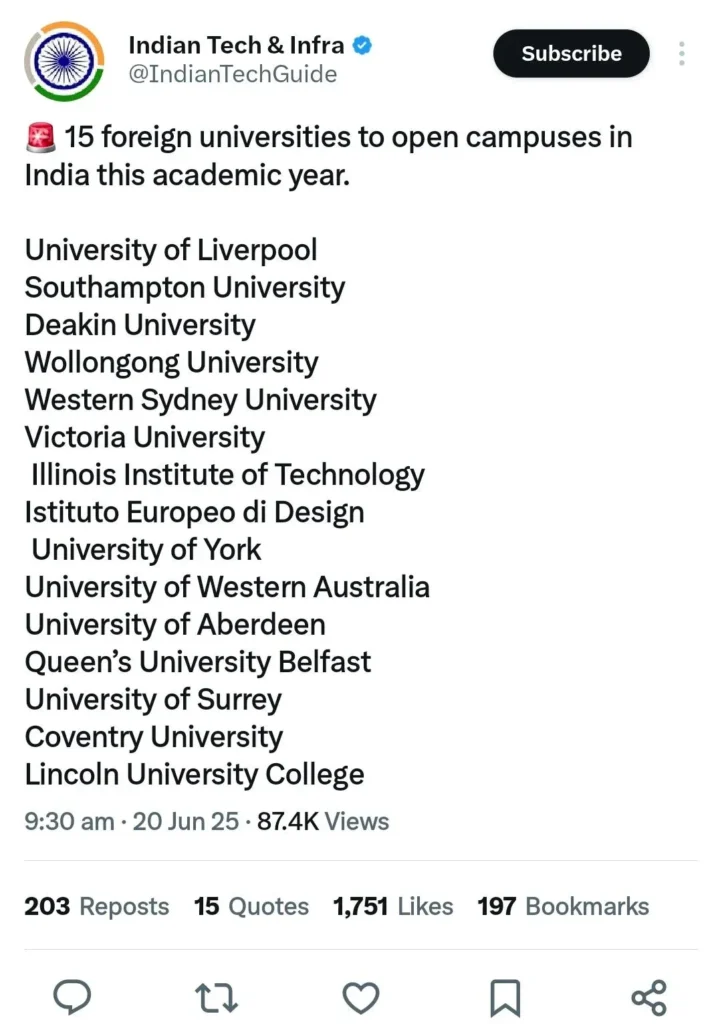
Indian Students Still Want International Degrees
The growing presence of foreign universities in India does not mean Indian students have suddenly lost interest in studying abroad.
International education continues to offer experiences that a domestic campus may not completely replicate.
Students who study overseas can experience a different academic culture, live independently, build international friendships and potentially develop professional networks in another country.
For some students, particularly those interested in careers that require international exposure, studying abroad will continue to be highly attractive.
But affordability is becoming a much bigger part of the conversation.
Tuition is only one component of the total cost of studying abroad. Students and families also have to consider accommodation, food, transportation, health insurance, travel, visa-related expenses and currency fluctuations.
That can make the total investment considerably higher than the tuition fee advertised by a university.
The Cost Advantage of Studying in India
This is where foreign university campuses in India could become particularly disruptive.
A student studying at an overseas campus may pay international tuition while also dealing with the cost of living in a major global city. A student attending the same university’s Indian campus may avoid many of those additional expenses.
The exact savings vary enormously depending on the university, course and location, so students should compare official fee structures rather than assume that every Indian campus will be inexpensive.
For example, Australia’s Deakin University opened its GIFT City campus in Gujarat in early 2024, offering postgraduate programs from its Indian location.
Deakin maintains a separate fee structure for GIFT City students, demonstrating how international universities can operate a campus in India with locally based students and costs rather than simply replicating the entire overseas study experience.
The result could create a new category between traditional Indian universities and studying overseas:
an international university experience at home.
What About Quality and Recognition?
Cost alone cannot determine whether a foreign university campus is worth choosing.
Students need to look carefully at recognition, accreditation, degree-awarding arrangements, faculty, curriculum, facilities, placements and the reputation of the specific campus.
This is particularly important because the phrase “foreign university in India” does not automatically mean that every program offers the same experience as the institution’s main overseas campus.
India’s regulatory framework provides requirements governing foreign higher-education institutions operating campuses in the country. The UGC also maintains regulations concerning recognition and equivalence of foreign qualifications.
Students should therefore check the official university and UGC information before making a decision.
The key question should not simply be:
“Is this a foreign university?”
It should be:
“What exactly will I receive from this campus, and where will the degree take me?”
Will Students Stop Going Abroad?
Probably not.
Instead, students may become more selective about why they go abroad.
A student whose primary goal is obtaining an international degree may decide that travelling overseas is no longer necessary if an equivalent university offers a suitable program in India.
But a student who wants international work experience, immigration opportunities, exposure to another culture or access to a particular research ecosystem may still prefer studying overseas.
This means foreign campuses could reduce some forms of study-abroad demand without eliminating the broader international education market.
In fact, they could make students more strategic.
Instead of thinking, “I need to leave India to get an international degree,” students may increasingly ask:
“What do I gain by leaving India that I cannot get here?”
That is a much more important question.
The Rise of the “Best of Both Worlds” Model
Foreign universities in India are effectively creating a middle ground.
Students can potentially access international academic brands while remaining close to their families and existing communities. They may avoid some international living expenses while still gaining exposure to global curricula and teaching approaches.
Recent reporting suggests Indian students are increasingly considering foreign university campuses in India because they combine international education with fewer visa and relocation barriers.
This model could be particularly appealing to families who want international education but are uncomfortable with the financial commitment or uncertainty associated with sending a young student overseas.
It could also make international education accessible to students who previously could not afford the total cost of studying abroad.
But Studying Abroad Still Has Advantages
Foreign campuses in India should not be treated as automatic replacements for overseas universities.
Studying in another country provides an experience that cannot simply be reproduced by changing the location of a classroom.
Students abroad can develop independence, interact with people from different countries, experience another society and potentially access local employment ecosystems.
There is also the question of networking.
A student studying in London, Melbourne, New York or another international city may build professional relationships that are difficult to replicate from India.
Therefore, the decision should ultimately depend on the student’s academic goals, career plans, finances and desired experience.
India Could Become an International Education Hub
The biggest change may not be that fewer Indians study abroad.
It may be that India itself becomes a bigger destination for international higher education.
As more foreign universities explore Indian campuses, competition could increase. Indian universities may face greater pressure to improve international collaborations, research opportunities, curriculum quality and student experiences.
Students, meanwhile, could gain more choices.
The traditional decision used to be:
Indian university vs foreign university.
The emerging decision could become:
Indian university vs foreign university in India vs foreign university abroad.
That is a much more competitive education market.
The Future of Studying Abroad Is Changing
Foreign universities entering India will not make overseas education disappear. But they could change the reason students choose to leave.
For some, an international degree in India may offer the right combination of quality, affordability and convenience.
For others, studying abroad will remain valuable because the experience itself—not just the degree—is the goal.
Ultimately, foreign university campuses could make Indian students less dependent on international relocation for accessing global education.
The biggest winner may be the student.
More competition means more choices, and more choices mean students can focus less on the idea that “foreign is always better” and more on finding the education that actually fits their ambitions.
The future may not be about choosing between India and the world. It may be about bringing more of the world to India.