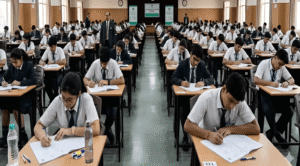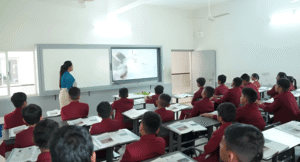
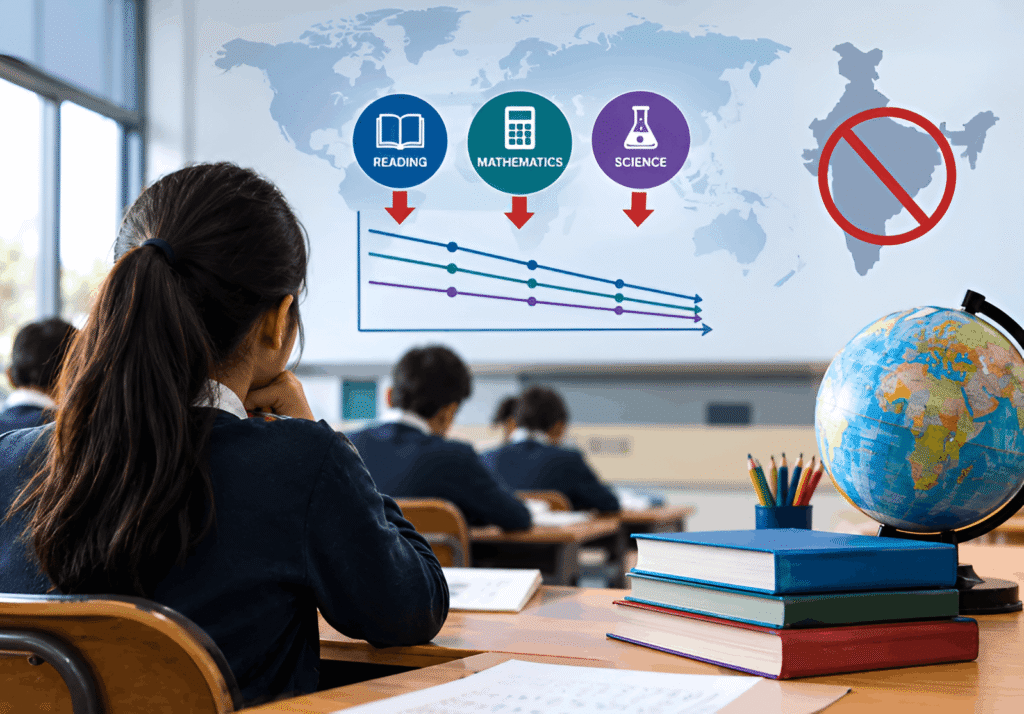
A major warning is emerging from international education data: students in many countries are struggling more with reading, mathematics and other essential skills than they did a few years ago.
The OECD’s PISA 2022 results recorded an unprecedented decline in student performance across many participating education systems. Compared with 2018, the average mathematics score across OECD countries fell by almost 15 points, while reading performance declined by 10 points. Science performance, however, did not show a significant average change.
PISA, or the Programme for International Student Assessment, evaluates how well 15-year-old students can apply knowledge and skills in reading, mathematics and science to real-world situations.
For students and educators in India, the results raise an important question: What can India learn from this global decline?
Why Are Reading Skills Declining?
The COVID-19 pandemic and school closures are an obvious part of the explanation. However, the OECD says the decline cannot be attributed entirely to the pandemic.
Reading and science performance had already been showing negative trends in several education systems before COVID-19. The PISA data therefore suggest that the problem may also involve deeper changes in how students learn, read and engage with information.
Today’s students are surrounded by short videos, social media posts, notifications and rapidly changing digital content. While digital technology can support education, constant exposure to short-form information can make sustained attention and long-form reading more challenging.
Reading skills are also about much more than knowing how to read words. Students need to understand arguments, identify important information, compare sources, interpret evidence and draw conclusions.
These skills are increasingly important in a world where students encounter enormous amounts of information every day.
What Does This Mean for Indian Students?
India needs to pay close attention to this global trend even though India was not among the participants in PISA 2022. Therefore, the international results cannot be used as a direct scorecard for Indian students.
However, the findings offer an opportunity to think about India’s own education priorities.
For Indian students, strong reading comprehension can influence performance across almost every subject. A student may know mathematics formulas or science concepts but still struggle if they cannot properly understand a question.
Similarly, higher education increasingly requires students to read textbooks, research papers, reports and digital resources independently.
This means reading comprehension is not only an English-subject skill. It is a foundation for academic success.
Reading Skills Matter in the Age of AI
The rise of artificial intelligence makes strong reading and comprehension skills even more important.
Students can now use AI tools to summarise information, explain difficult concepts or generate answers. But technology cannot replace the student’s ability to decide whether information is accurate, relevant or biased.
A student with strong reading skills can question an AI-generated answer, compare different sources and identify missing information.
In contrast, simply accepting every generated answer can create new learning problems.
This is why the future of education should not be about choosing between books and technology. Students need both digital literacy and strong foundational skills.
What Can Schools Do?
The global PISA results provide several lessons for schools and educators.
1. Encourage Regular Reading
Students should have opportunities to read beyond textbooks. Newspapers, essays, biographies, fiction, science articles and age-appropriate non-fiction can expose students to different writing styles and ideas.
2. Focus on Comprehension, Not Memorisation
Instead of asking students only to remember information, classrooms can include questions that require them to explain, compare, analyse and apply what they have read.
3. Build Digital Reading Skills
Reading on a screen is now unavoidable. Students need to learn how to evaluate online information, distinguish reliable sources from misleading claims and understand different viewpoints.
4. Reduce Learning Gaps
PISA data also highlight the connection between socioeconomic background and educational performance. Across OECD countries, disadvantaged students are significantly less likely to reach basic proficiency in mathematics.
India’s education system therefore needs to focus not only on high-performing students but also on ensuring that students from different backgrounds develop strong foundational skills.
Indian Students Need Skills for the Future
The global decline in reading and mathematics performance is more than a ranking issue. It raises concerns about whether education systems are giving young people the skills they need for higher education, employment and everyday life.
The good news is that the trend is not universal. Some education systems maintained or improved performance despite the disruption of recent years. Countries such as Japan, Korea and Singapore continued to demonstrate strong outcomes in the PISA assessment.
For India, the lesson is clear: academic success cannot depend only on marks and examinations.
Students need to become confident readers, critical thinkers, problem-solvers and responsible users of technology.
As AI and digital media continue to transform education, the ability to understand information may become one of the most valuable skills a student can develop.
The Bigger Question for India
The PISA results should not be viewed simply as a warning about declining test scores. They should encourage educators, policymakers, parents and students to ask a bigger question:
Are students learning how to think, or are they only learning how to answer?
For Indian students preparing for an increasingly competitive and technology-driven future, strong reading comprehension, mathematical reasoning and scientific thinking will remain essential.
The global learning slowdown is a challenge, but it can also be an opportunity for India to strengthen foundational learning and prepare students not just for exams, but for the world beyond the classroom.
Read More