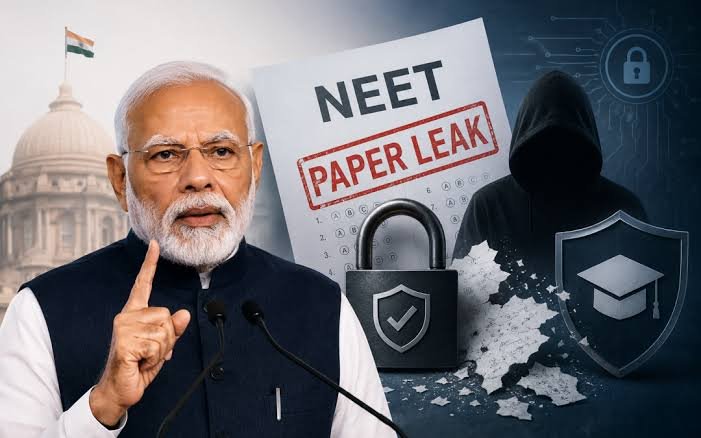
Prime Minister Narendra Modi has called for comprehensive reforms in India’s education and examination system, saying there will be no leniency towards those involved in paper leaks and examination-related malpractice.
His remarks came after Parliament passed the Public Examinations (Prevention of Unfair Means) Amendment Bill, 2026, which seeks to strengthen the legal framework against paper leaks and other unfair practices in public examinations.
PM Modi Says Paper Leaks Threaten Students’ Future
In a video message shared on social media, Prime Minister Narendra Modi said paper leaks have emerged as a major challenge for students and governments across the country.
He said repeated examination irregularities can affect students who spend years preparing for competitive and public examinations.
Modi said the government would not spare organised groups involved in paper leaks or those attempting to compromise the future of students.
The Prime Minister also stressed that tackling paper leaks requires reforms at both the Central and state levels rather than relying only on punishment after an incident occurs.
Parliament Passes Anti-Paper Leak Amendment Bill 2026
The Public Examinations (Prevention of Unfair Means) Amendment Bill, 2026 was passed by Parliament during the Monsoon Session.
The legislation amends the Public Examinations (Prevention of Unfair Means) Act, 2024 and introduces stronger penalties for examination-related offences.
The government has described the amendment as an effort to improve the integrity, transparency and credibility of public examinations.
The legislation comes amid growing concerns over examination irregularities and alleged paper leaks affecting major competitive examinations, including the NEET-UG examination.
Stricter Punishment for Paper Leaks
The amended framework increases penalties for individuals and organised groups involved in unfair means during public examinations.
According to details of the proposed amendments, punishment for certain offences involving the leakage of examination papers is being increased, while organised examination-related malpractice will attract substantially higher fines and imprisonment.
The government has argued that stronger penalties will act as a deterrent against organised examination malpractice.
Government Plans Task Force and Fast-Track Courts
PM Modi also highlighted measures aimed at strengthening the examination system.
The government has constituted a task force to examine ways of improving examination security and preventing irregularities. It has also proposed measures involving fast-track courts and has sought suggestions from states on strengthening examination procedures.
The broader objective is to ensure that students receive a fair opportunity based on merit and that examination systems are protected from organised malpractice.
Why Education System Reform Is Important
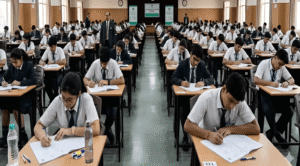
Paper leaks do more than affect the credibility of an examination. They can force students to repeat examinations, disrupt admission schedules and create uncertainty for candidates who have spent significant time and money preparing.
The government has therefore linked the fight against paper leaks with wider reforms in the education and examination system.
The Public Examinations Amendment Bill is intended to strengthen the legal response, while administrative and technological reforms will also be required to prevent leaks before they occur.
PM Modi Says Campaign Against Paper Leaks Will Continue
PM Modi said the government’s campaign against paper leaks would continue and reiterated that students must be provided with a fair and transparent examination system.
The passage of the Public Examinations (Prevention of Unfair Means) Amendment Bill, 2026 marks another step in the government’s effort to strengthen India’s public examination framework.
However, effective implementation will ultimately depend on how securely examination papers are prepared, stored and distributed, and how quickly authorities investigate and prosecute cases of malpractice.
For millions of students appearing for competitive examinations every year, the central concern remains the same: ensuring that hard work and merit, rather than leaked papers or organised cheating networks, determine examination outcomes.