Canada has long been one of the most popular destinations for Indian students seeking international education. Its universities and colleges offer programmes across technology, engineering, business, healthcare, science, management and other fields, while the country also provides opportunities for eligible international students to gain Canadian work experience after graduation.
However, studying in Canada in 2026 is different from the Canada of a few years ago.
The Canadian government has introduced significant changes to its international student system, including limits on study permit applications, new financial requirements, revised post-graduation work permit rules and tighter conditions around some programmes.
For Indian students, this means choosing a course and university requires more research than simply looking at tuition fees or assuming that graduation will automatically lead to a work permit or permanent residence.
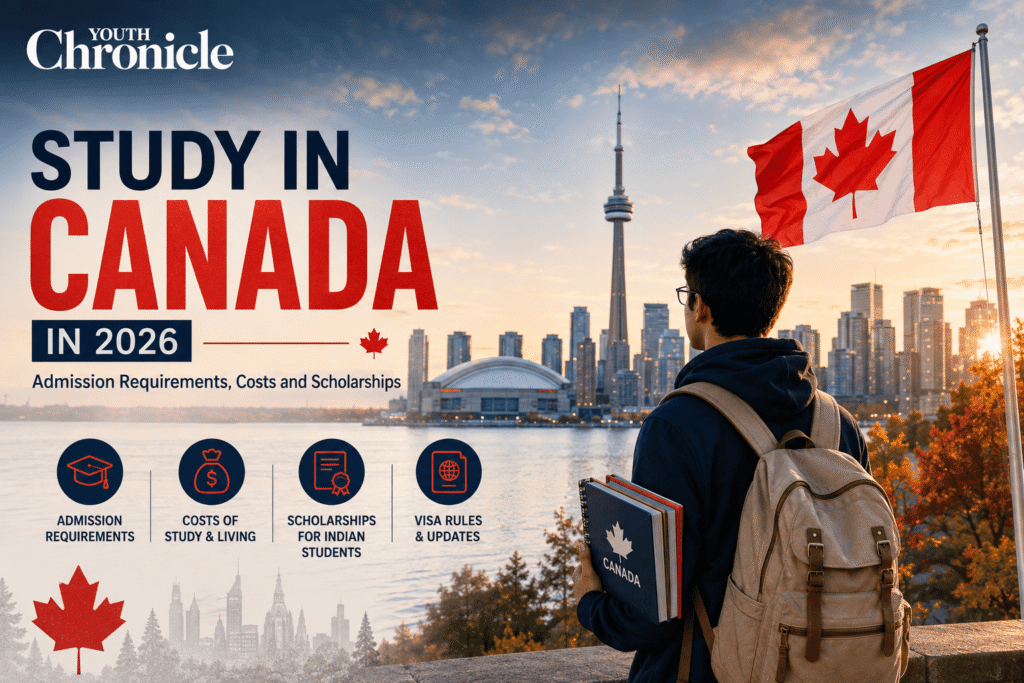
This guide explains the Canada admission requirements for Indian students, tuition fees, living costs, scholarships, study permit process, work rules and post-study opportunities in 2026.
Why Study in Canada in 2026?
Canada continues to offer a broad range of higher-education options for international students.
EduCanada, the Government of Canada’s official international education platform, allows students to search Canadian universities and colleges by programme and field, including business, engineering, finance, healthcare, information technology, law, nursing, science and sustainable technologies.
Canadian institutions are particularly relevant for students interested in:
- Computer science and information technology
- Artificial intelligence and data science
- Engineering
- Business and finance
- Healthcare
- Life sciences
- Environmental studies
- Research
- Management
- Social sciences
Major universities such as the University of Toronto, McGill University, University of British Columbia, University of Alberta, McMaster University and University of Waterloo remain prominent choices, but students should compare programmes rather than selecting a university purely because of its global ranking.
The most important question is:
Does this particular programme provide the academic and career pathway I need?
Top Canadian Universities Indian Students Can Consider
Canada has universities with different strengths, locations and programme structures.
University of Toronto
The University of Toronto is one of Canada’s major research-intensive universities, with programmes spanning engineering, computer science, business, medicine, social sciences, humanities and sciences.
It can be particularly relevant for students interested in research-intensive academic environments.
University of British Columbia
UBC offers undergraduate and graduate programmes across areas including engineering, computer science, business, sciences, forestry and health-related disciplines.
Its Vancouver location also provides access to a major technology and business ecosystem.
McGill University
Located in Montreal, McGill is internationally recognised for programmes across medicine, science, engineering, management, arts and other disciplines.
Students considering Quebec should separately research the province’s immigration and education requirements.
University of Waterloo
Waterloo is particularly well known for its technology, engineering, mathematics and co-operative education ecosystem.
It can be an attractive option for students seeking a strong connection between academic study and industry experience.
University of Alberta
The University of Alberta offers programmes across engineering, science, business, health, computing, agriculture and other fields.
McMaster University
McMaster has strong programmes in areas including health sciences, engineering, business, science and research.
These are only examples. Canada’s higher-education system includes many other universities and colleges, and the appropriate institution depends on the student’s course, budget and career objectives.
Admission Requirements for Indian Students
There is no single admission requirement for every Canadian university.
Each institution determines its own academic and language requirements.
For undergraduate admission, Indian students may generally need:
- Class 10 and Class 12 academic records
- Required subject prerequisites
- Proof of English-language proficiency where applicable
- Passport or identity documents
- Additional documents specified by the university
For postgraduate programmes, requirements can include:
- Bachelor’s degree
- Academic transcripts
- Minimum GPA or equivalent academic performance
- English-language proficiency
- Statement of purpose
- Letters of recommendation
- CV or résumé
- Research proposal for some programmes
- Portfolio for selected disciplines
- Relevant work experience where required
The exact requirements must be checked on the official website of the university and programme.
A student should never assume that meeting the minimum requirement of one Canadian university means they automatically qualify for another.
English-Language Requirements
International students may be required to demonstrate English-language proficiency for admission.
Commonly accepted tests include:
- IELTS
- TOEFL
- PTE Academic
- Other tests accepted by the individual institution
The required score depends on the university and programme.
This distinction is important because university admission requirements and Canadian immigration requirements are not necessarily identical.
Students should therefore check both.
Designated Learning Institutions: A Critical Check
Before applying, students should verify that their institution is a Designated Learning Institution (DLI).
A DLI is a school approved by a provincial or territorial government to host international students.
But there is an important distinction:
Being a DLI does not automatically mean every programme at that institution is eligible for a Post-Graduation Work Permit (PGWP).
IRCC specifically advises students to check whether their chosen programme is PGWP-eligible before applying.
This is one of the most important checks Indian students should make before paying tuition.
What Is the PAL/TAL Requirement?
Most international students applying for a Canadian study permit need a Provincial Attestation Letter (PAL) or Territorial Attestation Letter (TAL).
The letter confirms that the province or territory has allocated space for the student under Canada’s international student system.
In many cases, students need to accept their offer and pay some or all of their tuition before their institution can issue the PAL/TAL.
Important 2026 Change for Master’s and Doctoral Students
From 1 January 2026, students entering a degree-granting master’s or doctoral programme at a public Canadian institution do not need a PAL or TAL for their study permit application.
Students studying in Quebec still need to meet Quebec’s separate requirements.
This makes eligible public-university master’s and doctoral programmes particularly important for students planning postgraduate study in Canada.
How Much Does It Cost to Study in Canada?
Tuition varies considerably depending on:
- University
- Programme
- Level of study
- Province
- Institution
- Subject
Statistics Canada’s latest published national figures for the 2025/26 academic year put average tuition for international students at approximately:
CAD 41,746 per year for undergraduate programmes
and
CAD 24,028 per year for graduate programmes.
These are national averages, not fixed fees.
A particular programme can cost substantially more or less.
For example, professional programmes and some specialised courses can have significantly different fee structures.
Students should therefore use the university’s official fee calculator or programme page when preparing their budget.
Cost of Living in Canada
Tuition is only one part of the financial calculation.
Students must also budget for:
- Accommodation
- Food
- Transportation
- Health insurance
- Books and study materials
- Phone and internet
- Personal expenses
- Travel
- Emergency expenses
Toronto and Vancouver can be considerably more expensive than some smaller Canadian cities.
Choosing a university outside the most expensive metropolitan areas can sometimes reduce accommodation costs, although students should also consider employment opportunities and the overall quality and relevance of the programme.
Canada Study Permit Financial Requirement in 2026
One of the most important financial changes for international students is the updated cost-of-living requirement.
For applications made on or after 1 September 2025, a single student applying to study anywhere in Canada except Quebec must demonstrate CAD 22,895 for one year’s living expenses, excluding tuition and transportation.
For a family accompanying the student, the required amount increases.
For example:
| Family Size | Required Annual Living Funds |
|---|---|
| 1 person | CAD 22,895 |
| 2 people | CAD 28,502 |
| 3 people | CAD 35,040 |
| 4 people | CAD 42,543 |
These figures are updated periodically.
The financial requirement is in addition to tuition and transportation costs.
IRCC also requires applicants to demonstrate that they can support themselves without relying on employment in Canada.
This is an important point for Indian students:
Do not prepare a financial plan that assumes your part-time job will fund your entire education.
What Documents Are Needed for a Canada Study Permit?
A typical study permit application can require:
- Letter of Acceptance (LOA)
- PAL/TAL where applicable
- Valid passport
- Proof of financial support
- Academic documents
- Letter of explanation or other supporting information where appropriate
- Medical examination, if required
- Police certificate, if required
- Biometrics
- Other documents based on the applicant’s circumstances
IRCC’s current checklist states that a valid Letter of Acceptance is required in most cases and that applicants must provide proof of funds.
Students applying from India should also review the India-specific application instructions provided by IRCC.
Canada Study Permit Fees in 2026
The current Canadian study permit processing fee is:
CAD 150
The biometrics fee for an individual applicant is:
CAD 85
Therefore, a student who is required to provide biometrics will generally pay CAD 235 in these two charges, excluding other potential expenses such as medical examinations or document-related costs.
Fees can change, so applicants should verify the amount immediately before submitting their application.
Can Indian Students Work While Studying in Canada?
Eligible international students can work off campus while studying.
The current rule permits eligible students to work up to 24 hours per week during regular academic sessions.
During scheduled breaks, such as summer or winter holidays, eligible students can generally work unlimited hours, subject to the applicable conditions.
Students must also maintain their student status and actively pursue their studies.
Working beyond the permitted limit can violate study permit conditions and create immigration problems.
Therefore, part-time work should be treated as a supplementary source of income and experience, not as the foundation of an education-financing strategy.
Scholarships for Indian Students in Canada
Scholarships can reduce the cost of studying in Canada, but students should understand that there is no single government scholarship that automatically funds a Canadian degree for Indian students.
Funding opportunities vary according to the programme, institution, level of study and nationality.
University Scholarships
Canadian universities offer scholarships and awards to international students.
These can include:
- Entrance scholarships
- Academic merit scholarships
- Faculty-specific awards
- Graduate funding
- Research assistantships
- Teaching assistantships
- Need-based or programme-specific awards
The amount and eligibility criteria vary significantly.
Students should search the university’s official scholarship database before applying.
EduCanada Scholarship Opportunities
The Canadian government’s EduCanada platform maintains an official database of scholarship opportunities for international applicants.
Students can use the platform to identify programmes for which they may be eligible.
However, some government-funded programmes are designed for short-term study or exchange rather than full-degree study.
Study in Canada Scholarships
The Study in Canada Scholarships programme provides funding for eligible international students undertaking short-term study or research in Canada.
For the 2026-27 cycle, the programme is administered through Canadian post-secondary institutions, and individual students cannot directly apply to Global Affairs Canada under the programme.
The programme can cover eligible expenses such as airfare, living expenses, health insurance and visa or study-permit costs, depending on the scholarship arrangement.
Indian students should therefore check the eligibility list and participating institution arrangements rather than assuming this is a general full-degree scholarship.
Post-Graduation Work Permit: What Changed?
The Post-Graduation Work Permit (PGWP) allows eligible graduates to gain Canadian work experience after completing their studies.
But in 2026, students must be much more careful about PGWP eligibility.
Graduating from a DLI does not automatically guarantee PGWP eligibility.
Bachelor’s, Master’s and Doctoral Graduates
Graduates with bachelor’s, master’s or doctoral degrees generally do not face the PGWP field-of-study requirement.
However, language requirements apply to current PGWP applications.
For these degree graduates, the minimum language level is generally CLB 7 in English or NCLC 7 in French in all four language areas.
Other University Programmes
For graduates of other university programmes, field-of-study requirements can apply depending on when the student applied for their study permit.
For students who applied for a study permit on or after 1 November 2024, eligible non-degree programmes generally need to fall within an eligible field of study linked to Canada’s labour-market priorities.
For 2026, IRCC has stated that the list of eligible fields is frozen for the year, meaning no fields will be added or removed during 2026 under the current update.
This makes programme selection particularly important.
How Long Can the PGWP Last?
The length of a PGWP depends on the programme and other factors.
For eligible master’s degree programmes, a student can qualify for a three-year PGWP even if the master’s programme is less than two years, provided the programme is at least eight months long and other requirements are met.
For other eligible programmes:
- Programmes of at least 8 months but less than 2 years may result in a PGWP of up to the same length as the programme.
- Programmes of 2 years or more may result in a PGWP of up to 3 years.
The passport expiry date can also limit the actual permit period.
Can a Student’s Spouse Work in Canada?
Canada has also tightened dependant work-permit rules.
Since January 2025, spouses and common-law partners of international students may qualify for an open work permit in certain circumstances, including where the student is enrolled in a master’s programme of at least 16 months or a doctoral programme.
Students planning to move with a spouse should therefore check the current eligibility rules rather than assuming that every international student can bring a spouse with open work rights.
A Major 2026 Change: Co-op Work Permits
There is also a useful change for post-secondary students undertaking required work placements.
From 1 April 2026, eligible post-secondary international students no longer need a separate co-op work permit for student work placements such as required co-op placements or internships.
This simplifies the administrative process for eligible students.
Canada’s International Student Cap in 2026
Canada introduced limits on study-permit applications as part of its effort to manage the growth of the international student population.
The 2026 system continues to use provincial and territorial allocations to determine how many study-permit applications can be accepted for processing.
The government has said that the international student cap has contributed to a reduction in the number of study permit holders, with the population falling from more than one million in January 2024 to approximately 725,000 by September 2025.
This does not mean that students should avoid Canada altogether.
It means applications need to be planned carefully, and students should understand whether their chosen programme requires a PAL/TAL.
Eligible public-institution master’s and doctoral programmes receive a significant advantage in this respect because they are exempt from the PAL/TAL requirement from 2026.
How to Apply to Study in Canada
A practical application process looks like this:
Step 1: Choose Your Programme
Identify the course and specialisation that fit your academic background and career goals.
Step 2: Check the Institution
Confirm that the institution is a DLI.
If post-study work matters to you, check whether your specific programme is PGWP-eligible.
Step 3: Check Admission Requirements
Review academic, English-language and programme-specific requirements.
Step 4: Calculate the Total Cost
Include:
Tuition + accommodation + living costs + health insurance + travel + visa fees + emergency funds
Step 5: Apply to the Institution
Submit your application and required documents.
Step 6: Receive Your Letter of Acceptance
You need the LOA for your study-permit application.
Step 7: Arrange PAL/TAL if Required
If your programme does not qualify for an exemption, obtain the required provincial or territorial attestation.
Step 8: Prepare Financial Documents
Demonstrate sufficient funds for tuition, living expenses and transportation.
Step 9: Apply for the Study Permit
Submit the application online with the required documents and biometrics.
Step 10: Prepare for Arrival
Once approved, arrange accommodation, travel, health coverage and other practical requirements.
Is Canada Still Worth It for Indian Students in 2026?
Canada can still be an excellent destination for Indian students, but the decision should be made more carefully than in the past.
The country offers strong universities, research opportunities, industry exposure and post-study work opportunities for eligible graduates.
But the old assumption that:
“Study in Canada → work permit → PR”
is too simplistic.
Immigration outcomes depend on the programme, qualification, PGWP eligibility, language ability, work experience, occupation and the immigration rules in force at the time.
Students should therefore choose their programme primarily for its academic and career value, while treating immigration as an important but separate consideration.
Canada Study Abroad Checklist for Indian Students in 2026
Before paying a deposit, verify:
- Is the institution a DLI?
- Is the specific programme PGWP-eligible?
- Do you need a PAL/TAL?
- What are the exact tuition fees?
- What are the accommodation costs?
- Can you demonstrate the required financial funds?
- Does the university accept your academic qualification?
- What English-language score is required?
- Are scholarships available?
- How long can the programme take?
- What PGWP rules apply to your programme?
- Are you eligible to work during your studies?
- If travelling with family, are they eligible for the relevant permits?
Final Thoughts
Canada remains an important study-abroad destination for Indian students in 2026, but the rules have become significantly more structured.
The CAD 22,895 living-cost financial requirement, the 24-hour weekly off-campus work limit, PAL/TAL requirements for many students and the revised PGWP framework all need to be understood before applying.
At the same time, there are positive developments for certain students. From 2026, students entering eligible master’s and doctoral degree programmes at public institutions do not need a PAL/TAL, and eligible post-secondary students no longer need a separate co-op work permit for required placements.
For Indian students, the best approach is therefore to look beyond the country’s reputation.
Choose the right programme, at the right institution, at a cost you can realistically afford, with a clear understanding of its post-study work eligibility.
Canada can still provide a valuable international education and career experience. But in 2026, informed decision-making matters more than ever.