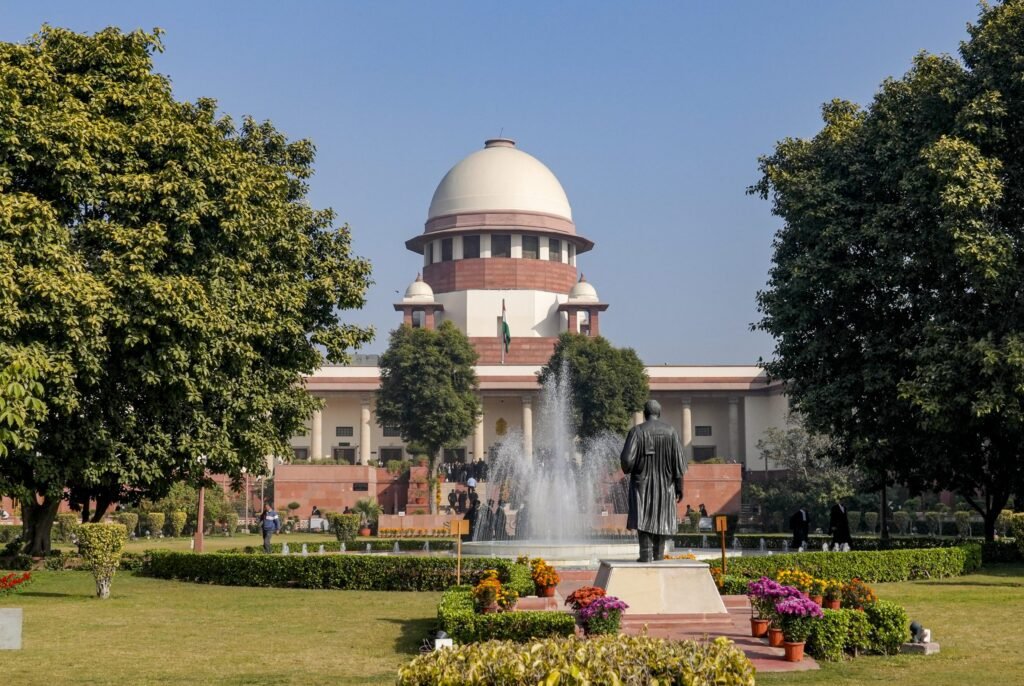
The Supreme Court is hearing a batch of petitions alleging excessive police action against students and other protesters during demonstrations over the alleged NEET-UG 2026 paper leak and examination irregularities.
A bench headed by Chief Justice Surya Kant, along with Justices Joymalya Bagchi and V. Mohana, is examining allegations concerning the use of force during the protests and whether an independent investigation is required.
The case has raised broader questions about the right to peaceful protest and the limits of police action during public demonstrations.
Supreme Court Examines Alleged Police Excesses
The petitions allege that police used excessive force against protesters during demonstrations linked to the NEET paper leak controversy.
Among the allegations are the use of pellet guns, nail-studded lathis, rubber bullets and electric batons, with petitioners claiming that several students and other protesters were injured.
The Supreme Court has stressed that the constitutional right to peaceful protest cannot be disregarded merely because an agitation is taking place. The court has also indicated that violence by protesters and excessive force by police both require scrutiny.
Court Considers Independent Investigation
The Supreme Court has indicated that it may consider an independent investigation, potentially through a Special Investigation Team (SIT), into allegations of police excesses and violence during the protests.
The court is also examining allegations concerning injuries to police personnel during the demonstrations. The proposed investigation would therefore need to examine allegations against both protesters and law-enforcement personnel.
The court has emphasised the need to identify those responsible for any excesses rather than assuming responsibility on either side.
No Coercive Action Against Protesting Students
On July 28, the Supreme Court directed authorities not to take coercive action against students who participated in the protests, except in cases involving individuals with criminal antecedents.
The court also directed authorities to release detained protesters below the age of 18 who had no criminal antecedents.
At the same time, the court allowed investigations into FIRs that had already been registered.
Supreme Court Orders Preservation of Evidence
The court has directed authorities to preserve evidence connected with the protests.
This includes CCTV footage, drone recordings, body-camera footage, wireless communication records, PCR logs and other relevant digital evidence.
The court has also directed that personal information and digital data relating to protesters should not be publicly disclosed.
These directions are intended to ensure that evidence relevant to allegations of police excesses and protest-related violence remains available for investigation.
States Asked to Respond
The Supreme Court has sought responses from several state governments in connection with the petitions.
The proceedings involve allegations arising from protests held in different parts of the country following the controversy surrounding examination irregularities and the NEET paper leak.
The court’s consideration of an independent mechanism could determine how allegations of police excesses are investigated across the affected jurisdictions.
Why the Case Matters
The Supreme Court proceedings have significance beyond the NEET paper leak controversy.
The case involves two competing concerns: the constitutional protection of peaceful protest and the state’s responsibility to maintain public order and protect police personnel.
The court has indicated that both sides must exercise restraint. While peaceful demonstrations are constitutionally protected, violence against police officers or damage to public property cannot be ignored.
The proceedings could also lead to broader guidelines concerning police conduct during protests if the Supreme Court ultimately decides that a uniform framework is necessary.
For students and protesters involved in the demonstrations, the court’s interim directions provide important protection against coercive action while investigations continue.
The Supreme Court’s further hearings will determine how the allegations of police excesses and protest-related violence are investigated and whether an independent SIT or other mechanism is ultimately constituted.