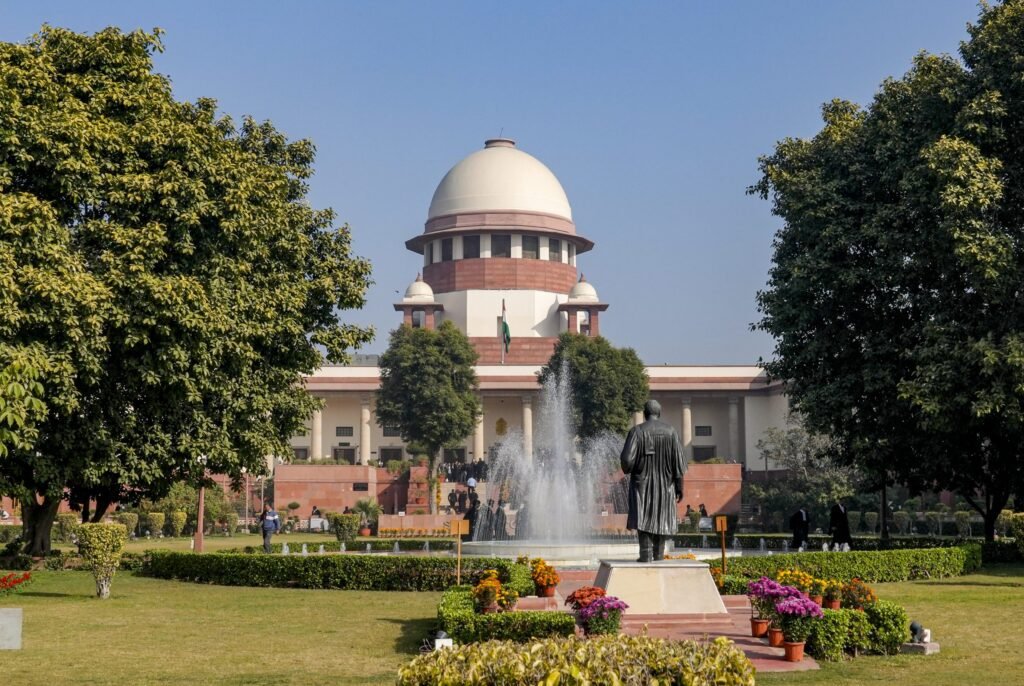
The Supreme Court has been urged to urgently hear petitions challenging the Central Board of Secondary Education’s (CBSE) three-language policy for Class 9 students, which came into effect from the 2026-27 academic session.
The challenge comes amid concerns from parents and other petitioners over the availability of teachers, textbooks and other resources required to implement the new CBSE three-language rule.
Supreme Court Asked to Hear CBSE Language Policy Challenge
Senior advocate Gopal Sankaranarayanan, appearing for one of the petitioners, sought an urgent listing of the matter before a bench headed by Chief Justice Surya Kant, along with Justices Joymalya Bagchi and V. Mohana.
The petitioners argued that the academic session has already started and that schools are facing difficulties in implementing the three-language requirement.
They have raised concerns over the availability of adequate teachers and textbooks, particularly for different Indian languages.
The Supreme Court had earlier sought responses from the Centre, NCERT and CBSE on the petitions challenging the policy. The Centre, CBSE and NCERT have defended the framework, saying it is aligned with the National Education Policy (NEP) 2020 and seeks to promote multilingualism.
What Is CBSE’s Three-Language Rule for Class 9?
Under a CBSE circular issued on May 15, 2026, students entering Class 9 from the 2026-27 academic session are required to study three languages, identified as R1, R2 and R3.
At least two of the three languages must be native Indian languages.
Students who want to study a foreign language can choose it as the third language only when their other two languages are Indian languages. A foreign language can also be taken as an additional fourth language.
The revised language framework is linked to the National Education Policy 2020 and the National Curriculum Framework for School Education (NCF-SE) 2023.
Why Are Parents and Petitioners Challenging the Policy?
The petitioners have questioned the timing and practical implementation of the CBSE three-language policy.
One of the major concerns is whether CBSE-affiliated schools have enough qualified teachers to teach the additional languages. Petitioners have also raised concerns about the availability of appropriate textbooks and learning resources.
The challenge also questions whether students should be required to adopt the new language structure after the academic year had already begun.
Earlier proceedings before the Supreme Court also highlighted logistical concerns surrounding the implementation of the policy.
CBSE Defends the Three-Language Policy
CBSE has defended the policy before the Supreme Court, pointing to the availability of Indian-language teaching capacity across its affiliated schools.
According to figures submitted by the Board, 47.3% of its 28,848 affiliated schools already offer two or more native Indian languages to Class 9 students. CBSE has also said that interim staffing arrangements can be used where schools need additional support.
The Centre and NCERT have similarly defended the policy as part of the broader multilingual education framework under NEP 2020.
No Class 10 Board Examination for Third Language
The new CBSE framework does not introduce a separate Class 10 Board examination for the third language.
The arrangement is intended to limit additional board-examination pressure on students while still requiring them to study the third language as part of the school curriculum.
What Happens Next?
The Supreme Court’s proceedings will determine how the legal challenges to the CBSE three-language policy develop. For now, the policy remains in operation for the 2026-27 academic session.
The case is significant for Class 9 students, parents and CBSE-affiliated schools because the outcome could affect the implementation of the three-language framework and the way schools organise language teaching in the coming academic years.
Students and parents should rely on official CBSE notifications and subsequent Supreme Court orders for any changes to the current policy.