Technology education in schools is often discussed in terms of devices, coding platforms, robotics kits and digital content. But introducing technology into a classroom and building a sustainable technology education system are two very different challenges.
For Dr Gunjan S Jhajharia, founder of Aaklan, the larger problem was not whether schools wanted technology. It was whether they had the infrastructure, people and execution systems required to make technology education work consistently inside classrooms.
This challenge became particularly visible during the pandemic.
Schools were willing to adopt technology, students were ready to learn and parents increasingly understood the importance of digital skills. Yet many institutions struggled to convert these intentions into structured, sustainable academic programs.
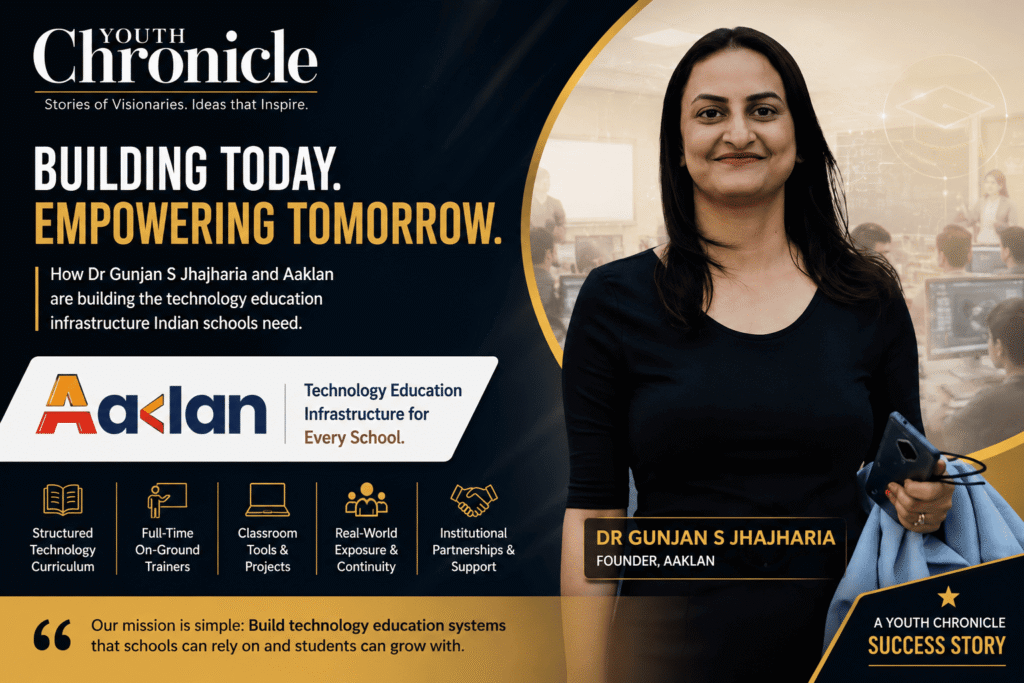
Through Aaklan, Dr Gunjan is addressing this execution gap by building technology education infrastructure that integrates curriculum, trainers, classroom tools and institutional processes into a single system.
Rather than positioning Aaklan simply as another EdTech platform, the company works as an institutional technology education partner for schools.
Who Is Dr Gunjan S Jhajharia?
Dr Gunjan S Jhajharia is the founder of Aaklan, an education venture focused on building technology education infrastructure within schools.
Her entrepreneurial journey developed through close interactions with school management teams, educators and educational institutions.
These experiences allowed her to observe how technology programs actually function once they move beyond presentations and proposals and enter real classrooms.
One recurring problem became increasingly visible.
Schools were experimenting with technology education, but implementation was often fragmented.
One vendor might provide hardware. Another might provide digital content. External trainers could conduct occasional workshops, while separate after-school programs offered additional exposure.
Each component could be useful individually, but schools were often left responsible for bringing all of them together.
The result could be activity without continuity.
For Dr Gunjan, this raised a more fundamental question: who takes responsibility for ensuring that technology education actually runs inside a school every day?
That question became central to Aaklan.
What Is Aaklan?
Aaklan is a technology education infrastructure company founded by Dr Gunjan S Jhajharia that works with schools to implement structured technology learning systems.
Instead of functioning primarily as a course provider, content platform or hardware vendor, Aaklan positions itself as an institutional infrastructure partner.
Its model integrates key components required to run technology education within schools, including:
- Structured technology curriculum
- Full-time on-ground trainers
- Classroom learning tools
- Project-based education
- Academic integration
- Operational support
- Real-world technology exposure
- Long-term program continuity
The objective is not simply to introduce students to technology through occasional activities.
Aaklan aims to make technology education a sustained part of the school’s academic environment.
The Structural Gap Dr Gunjan Identified in Schools
The pandemic accelerated conversations around technology adoption in education.
However, it also exposed structural weaknesses.
Many schools wanted to introduce technical education but lacked the internal resources necessary to operate it effectively.
Technology companies could supply equipment.
EdTech platforms could provide content.
Consultants could recommend strategies.
After-school programs could provide additional learning opportunities.
But these different components did not necessarily create a functioning institutional system.
School management teams could still be responsible for coordinating vendors, trainers, curriculum and academic schedules.
Teachers might be asked to adopt new tools without sufficient support.
Students could experience programs that began enthusiastically but lacked long-term continuity.
Dr Gunjan concluded that the missing element was not another individual technology product.
It was execution infrastructure.
Aaklan’s Approach to Technology Education
Aaklan approaches technology education from the perspective of the school rather than beginning with a particular product.
This distinction influences how programs are implemented.
Instead of requiring institutions to redesign their academic structures around an external platform, Aaklan adapts its model according to the school’s schedule, capacity and existing academic environment.
The objective is to reduce operational friction for institutions.
Curriculum, trainers, tools and delivery are designed to function as interconnected parts of one system.
This shifts the focus from purchasing technology to operating technology education.
For schools, the distinction can be significant.
Buying equipment is a one-time transaction.
Building an academic system requires consistent execution.
Full-Time Trainers Inside Partner Schools
One of the defining features of Aaklan’s model is the deployment of full-time on-ground trainers within partner schools for the complete academic session.
This approach differentiates the company from models based primarily on occasional workshops or short-term external training.
A trainer who remains embedded within a school can develop familiarity with students, academic schedules, institutional expectations and classroom dynamics.
Continuity also allows learning to progress systematically rather than restarting with each external session.
For students, this can create a more stable learning environment.
For school management, it reduces dependence on coordinating different trainers or vendors throughout the year.
For Aaklan, the model creates direct responsibility for execution.
From Technology Exposure to Project-Based Outcomes
Technology education can easily become limited to exposure.
Students may attend a robotics workshop, experiment with a coding tool or watch demonstrations of emerging technologies.
While such exposure can be valuable, Aaklan’s model emphasizes project-based outcomes.
Students are encouraged to use technology to create and solve problems rather than simply observe it.
This approach connects technical concepts with practical application.
The objective is to move students from asking what a technology does to understanding how they can use it.
Project-based learning also gives educators a clearer way to evaluate whether students are developing actual capabilities rather than merely participating in activities.
Why Aaklan Does Not Position Itself as a Conventional EdTech Platform
Aaklan’s positioning is deliberately different from conventional EdTech models.
Many digital education companies operate outside the school’s normal academic structure.
Students log into an external application or attend learning sessions separately from their regular classroom experience.
After-school programs similarly operate alongside the school system.
Hardware companies generally focus on providing devices or laboratory infrastructure.
Each of these models solves a particular part of the technology education problem.
Aaklan attempts to integrate the different components from inside the institution.
Its model focuses on curriculum, classroom execution, trainers, tools and continuity.
The company therefore views itself less as an additional educational layer and more as part of the infrastructure required to operate technology education within the school.
Building Trust After Fragmented Technology Implementations
Schools have been exposed to numerous education technology initiatives over the years.
Not every implementation has produced sustainable results.
Programs can begin with ambitious promises but lose momentum after trainers change, vendors disappear or academic priorities shift.
Repeated experiences of fragmented implementation can make institutions cautious about adopting new programs.
For Aaklan, building institutional trust therefore required demonstrating continuity.
The company’s response was to take greater ownership of execution.
Rather than supplying one component and leaving implementation to the institution, Aaklan attempts to coordinate the system over an extended academic period.
This focus on execution became an important part of the company’s relationship with partner schools.
Leela: A Microcontroller Designed Around School Classrooms
One of the important milestones in Aaklan’s development was the creation of Leela, its microcontroller board.
Educational hardware is often adapted from products originally designed for engineering students, hobbyists or industrial applications.
Such products may assume extended laboratory sessions, experienced technical facilitators or users with prior electronics knowledge.
School classrooms operate differently.
Periods may last approximately 45 minutes.
Students are younger.
Teachers and trainers must work within academic schedules.
Technical complexity that might be manageable inside an engineering laboratory can become an obstacle inside a school classroom.
Aaklan therefore developed Leela around these classroom constraints.
Rather than designing a technology product first and later finding an educational use for it, the company approached the problem from the school environment.
The objective was to reduce unnecessary complexity and create a tool suitable for structured classroom learning.
Why Classroom Context Matters in Education Technology
Leela also represents a broader principle within Aaklan’s product philosophy.
Educational technology cannot be evaluated only by technical capability.
A sophisticated tool may still fail in a school if it cannot be implemented within classroom constraints.
The academic timetable matters.
Teacher capacity matters.
Student age matters.
Training continuity matters.
The amount of time available for each lesson matters.
Aaklan’s approach attempts to account for these operational realities before deciding how technology should be introduced.
For Dr Gunjan, understanding the customer’s environment in detail is therefore as important as understanding the technology itself.
Aaklan’s Expansion Across Indian Schools
Aaklan has expanded its operations across multiple states as it develops its institutional technology education model.
Rather than focusing primarily on selling additional products, the company’s growth has been linked to establishing long-term relationships with schools.
Institutional confidence becomes particularly important in this model.
Schools are not simply purchasing access to software.
They are allowing an external education partner to become involved in curriculum execution and classroom learning over an academic session.
This requires a higher level of trust and operational accountability.
Aaklan’s expansion therefore depends heavily on its ability to demonstrate that its systems can function consistently within different school environments.
Startup Recognition and Institutional Support
Aaklan’s development has also received recognition within India’s startup ecosystem.
According to information provided by the company, Aaklan secured funding from a Mumbai-based venture capital firm.
The venture was also recognized as the Most Scalable Women Startup from Rajasthan by TiE Rajasthan.
Aaklan is additionally incubated at PIEDS, the BITS Pilani incubation centre, strengthening its connection with the startup and innovation ecosystem.
These developments reflect the company’s transition from an education initiative into a potentially scalable institutional infrastructure model.
For Dr Gunjan, however, scale remains closely connected with execution.
Expanding into additional schools is meaningful only if the quality and continuity of implementation can be maintained.
Aaklan and the Future of STEM and Technology Education
Technology skills are becoming increasingly relevant at earlier stages of education.
Students are growing up in an environment shaped by artificial intelligence, automation, electronics, software and connected devices.
Schools therefore face increasing pressure to provide learning experiences that prepare students for this technological environment.
But introducing more tools does not automatically create better technology education.
Students need structured progression.
Teachers and trainers need support.
Projects need to connect concepts with practical outcomes.
Schools need systems capable of operating throughout the academic year.
Aaklan’s model attempts to bring these requirements together within one institutional framework.
Building Technology Education as School Infrastructure
One of the most significant ideas behind Aaklan is the treatment of technology education as infrastructure rather than an extracurricular activity.
Traditional school systems already contain established infrastructure around subjects such as Mathematics, Science and Languages.
There are curricula, teachers, timetables, assessments and progression structures.
Technology education often lacks the same institutional consistency.
Aaklan’s long-term model attempts to move technology learning closer to this level of integration.
This means making it predictable enough to operate every academic year rather than depending on isolated workshops or short-term initiatives.
If technology education is expected to become a fundamental capability for future generations, the systems delivering it may need to become equally fundamental.
The Future Vision of Aaklan
Over the next five years, Aaklan aims to deepen its presence across India and build a large institutional network focused on school-based technology education.
The objective extends beyond market expansion.
Dr Gunjan’s vision is to establish a systemic presence within school education.
This involves developing a model capable of operating consistently across different institutions while adapting to their individual requirements.
The company also sees potential beyond India.
Schools in other education systems can face similar implementation challenges when attempting to integrate technology into conventional academic structures.
A model built around curriculum, trainers, classroom tools and execution could therefore have relevance in international markets as well.
Dr Gunjan S Jhajharia’s Advice to Emerging Entrepreneurs
Dr Gunjan’s entrepreneurial philosophy reflects the institutional nature of Aaklan’s business.
Her advice begins with understanding the customer beyond their stated requirements.
For founders, this means studying how customers actually operate.
What happens during their normal day?
What creates friction?
Which stakeholders influence decisions?
Why have previous solutions failed?
What prevents implementation even when there is interest?
These questions can reveal opportunities that are not visible when entrepreneurs focus exclusively on products.
Dr Gunjan’s experience with schools led her to conclude that innovation does not always require inventing another standalone technology.
Sometimes, the larger opportunity lies in building the ecosystem required to make existing technologies work.
Dr Gunjan S Jhajharia and the Future of Aaklan
The journey of Dr Gunjan S Jhajharia and Aaklan represents a different approach to technology education.
Instead of asking schools to purchase more disconnected tools, the company is attempting to build the infrastructure required to make technology learning operate as a sustained academic function.
Its model combines curriculum, full-time trainers, classroom technology, project-based learning and institutional execution.
The development of Leela, Aaklan’s classroom-focused microcontroller, further reflects this approach by designing technology around the realities of school learning rather than adapting complex tools after the fact.
As schools prepare students for a world increasingly shaped by technology, the central challenge may no longer be whether technology should enter classrooms.
The more important question is how schools can make technology education work consistently once it gets there.
For Dr Gunjan and Aaklan, the answer lies in execution.
Technology may provide the tools, but sustainable educational impact depends on building systems capable of making those tools work every day.
To learn more about Dr Gunjan S Jhajharia and Aaklan:
🌐 Website: https://www.aaklan.com/
💼 LinkedIn: https://www.linkedin.com/in/gunjanjhajharia/
📸 Instagram: https://www.instagram.com/gunjan_jhajharia/