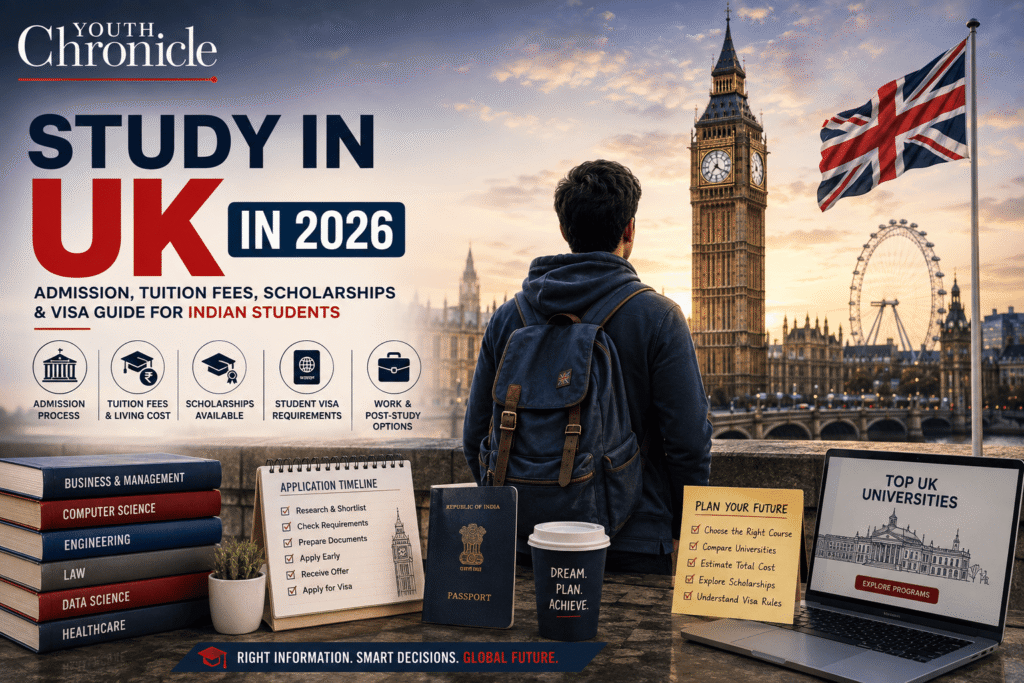
The United Kingdom remains one of the most popular destinations for Indian students seeking an international degree. Its universities offer a wide range of undergraduate and postgraduate programmes, while many master’s degrees can be completed in just one year.
But studying in the UK in 2026 requires more than choosing a university and arranging funds.
Tuition fees, living expenses, scholarship opportunities, admission requirements and immigration rules all need to be considered before making a decision. The UK has also changed several aspects of its student and post-study immigration system, making it important for students to rely on current official information rather than older study-abroad advice.
For Indian students planning to study in the UK in 2026, this guide explains the admission process, tuition fees, scholarships, Student visa requirements, living costs, work rules and post-study options.
Why Study in the UK in 2026?
The UK continues to attract international students because of its large higher-education system and internationally recognised universities.
Another important advantage is the duration of many postgraduate programmes. According to the British Council’s Study UK platform, many UK master’s programmes can be completed in one year, allowing students to obtain a postgraduate qualification without spending two or more years on the degree.
The UK also offers programmes across virtually every major academic field, including:
- Business and management
- Computer science
- Artificial intelligence
- Engineering
- Law
- Finance
- Economics
- Medicine and healthcare
- Data science
- Social sciences
- Design and creative disciplines
- Research and STEM
However, the UK should not be selected simply because it is a popular destination.
Students need to compare the specific university, course, total cost and career prospects before applying.
Undergraduate vs Master’s Study in the UK
The application process is different depending on the level of study.
Undergraduate Courses
International students applying for most undergraduate programmes generally apply through UCAS, the UK’s central university admissions service.
Students can apply to up to five courses through a UCAS application, although there are specific rules and exceptions for certain subjects and institutions.
Postgraduate Courses
Postgraduate admissions are usually handled directly by universities.
There is no single application system covering all master’s programmes. Each university and course can have its own entry requirements, application process and deadline. Many postgraduate programmes do not have a fixed deadline, although universities recommend applying early because popular courses can fill their available places.
UK University Admission Requirements for Indian Students
There is no single set of admission requirements for every UK university.
Requirements depend on:
- University
- Course
- Academic level
- Previous qualification
- Subject background
- English-language ability
- Competition for the programme
For undergraduate applicants from India, universities generally assess the student’s Indian school-leaving qualification and grades against their own course requirements.
For master’s applicants, universities normally consider the applicant’s undergraduate degree, academic performance and relevant background.
Some programmes may also require:
- Relevant work experience
- Portfolio
- Interview
- Entrance test
- Professional qualification
- Specific undergraduate subjects
The British Council advises international students to check the individual university’s course page for the equivalent qualifications and exact entry requirements because these can differ significantly between institutions.
English Language Requirements
Indian students may need to demonstrate English-language proficiency depending on the university, course and their previous education.
IELTS is widely accepted, but it is not the only English-language test used by UK universities.
Some institutions may accept other tests or qualifications, while certain applicants may qualify for an English-language exemption.
Therefore, students should not assume that a particular IELTS score automatically applies to every university.
The correct approach is to check the English-language requirement on the specific course page.
The British Council notes that requirements vary by university and course, although an IELTS score of around 6.0 is a common baseline in some contexts. Competitive programmes can require higher scores.
UK University Application Timeline
Undergraduate Applications
For the 2026 UCAS cycle, the main equal-consideration deadline for most undergraduate courses was 14 January 2026 at 18:00 UK time. The final date for most applications was 30 June 2026 at 18:00 UK time, after which new applications are entered into Clearing.
There are important exceptions.
Applications for Oxford and Cambridge and most medicine, dentistry and veterinary courses have an earlier October deadline.
What About Students Applying Now?
For students reading this article in August 2026, the standard 2026 undergraduate deadlines have already passed.
However, Clearing remains relevant for courses with available places. UCAS states that Clearing opened on 2 July 2026, while the 2026 application cycle closes later in the year.
Students should check the current UCAS course listings and contact universities directly to confirm whether international applicants are still being accepted and whether there is sufficient time to complete the visa process.
For students planning for the next academic cycle, preparing applications well before the deadline is strongly preferable.
How Much Does It Cost to Study in the UK?
The cost depends heavily on the university, course and location.
According to the British Council’s Study UK guidance, international undergraduate tuition fees generally range from approximately £11,400 to £38,000 per year.
For international postgraduate programmes, the stated range is approximately £9,000 to £30,000 per year.
These are broad ranges rather than fixed fees.
A specific master’s programme at one university could cost substantially more or less than another programme.
Students should therefore use the university’s official course page when calculating their actual tuition costs.
Living Costs
Living expenses are another major component of the budget.
Study UK estimates that international students may need approximately:
- £1,300-£1,400 per month in London
- £900-£1,300 per month elsewhere in the UK
These estimates cover accommodation, bills, groceries and other living expenses.
Actual costs can vary substantially depending on accommodation, city and lifestyle.
London is generally more expensive than many other UK cities, so students on a limited budget should compare locations rather than looking only at university rankings.
Student Visa Financial Requirement in 2026
International students applying for a UK Student visa must normally demonstrate that they have sufficient funds to support themselves and pay their course fees, subject to the applicable exemptions.
The current maintenance requirement is:
£1,529 per month for courses in London, for up to nine months
and
£1,171 per month for courses outside London, for up to nine months.
This means the maintenance evidence alone can amount to:
London: £13,761 for nine months
Outside London: £10,539 for nine months
This is separate from tuition fees.
Students should therefore calculate their visa financial requirement alongside their actual expected living expenses.
The financial requirement is not necessarily the same as the total amount a student will spend.
UK Student Visa: Eligibility and Process
Most Indian students studying a full-time higher-education course in the UK for more than six months will need a Student visa.
The basic process is:
Step 1: Choose a Course and University
Select a university and programme that is appropriate for your academic background and career goals.
Step 2: Apply to the University
Submit the required academic documents, personal statement or other application materials, references and English-language evidence where required.
Step 3: Receive Your Offer
The university may issue either a conditional or unconditional offer.
Step 4: Meet the Conditions
If the offer is conditional, satisfy the university’s requirements.
Step 5: Receive Your CAS
Once the university is ready to sponsor your Student visa application, it issues a Confirmation of Acceptance for Studies (CAS).
The CAS is required for the visa application.
Step 6: Apply for the Student Visa
Students applying from outside the UK can apply for a Student visa up to six months before the course begins.
The Student visa application fee for applications from outside the UK is currently £558.
Immigration Health Surcharge
Students staying in the UK for longer periods also have to pay the Immigration Health Surcharge (IHS) as part of the visa process.
The current discounted student rate is £776 per year. The amount actually payable depends on the length of the visa and how the charge is calculated for the specific period.
Therefore, students should not calculate their total visa expense using only the £558 application fee.
Can Indian Students Work While Studying in the UK?
Eligible international students can work subject to the conditions attached to their Student visa.
For a full-time degree-level course sponsored by an eligible higher-education provider, the standard permission is up to 20 hours per week during term time, with full-time work generally permitted during vacations.
However, students should not build their entire financial plan around part-time employment.
Part-time work can provide experience and supplementary income, but it should not be treated as a guaranteed method of paying tuition fees and living costs.
The primary purpose of the Student visa remains study.
Scholarships for Indian Students in the UK
Scholarships can significantly reduce the financial burden of studying abroad.
However, students should distinguish between fully funded scholarships, tuition-fee awards and partial university scholarships.
Chevening Scholarships
The Chevening Scholarship is one of the UK’s best-known international scholarship programmes.
It supports outstanding emerging leaders from around the world to pursue one-year master’s degrees in the UK.
For the 2027-28 cycle, Chevening applications opened on 4 August 2026 and the deadline is 6 October 2026 at 11:00 UTC.
Indian students interested in a fully funded master’s opportunity should examine the eligibility criteria carefully rather than assuming that admission to a UK university automatically makes them eligible.
GREAT Scholarships
The GREAT Scholarships programme provides eligible students from participating countries, including India, with £10,000 toward tuition fees for a range of one-year taught postgraduate courses.
For the 2026-27 academic year, the programme offers more than 140 scholarships through more than 60 universities across the UK.
For Indian applicants, the British Council’s official India page lists participating universities and states that applicants must generally hold an undergraduate degree, meet the university’s English-language requirements and satisfy the individual scholarship criteria. Deadlines vary by institution.
Commonwealth Scholarships
Commonwealth Scholarships support talented students from Commonwealth countries pursuing postgraduate study in the UK.
The Commonwealth Scholarship Commission states that applications for the 2026/27 Commonwealth Master’s Scholarships are closed.
Students planning future intakes should monitor the official Commonwealth Scholarship Commission and Study UK websites for new application cycles.
University-Specific Scholarships
Many UK universities offer their own scholarships and fee reductions for international students.
These can vary considerably.
Before applying, check:
- Eligibility
- Nationality requirements
- Academic requirements
- Scholarship amount
- Application deadline
- Whether a separate application is required
- Whether the award is renewable
Do not assume that every university automatically considers international applicants for every scholarship.
What Happens After Graduation?
The UK has a Graduate route allowing eligible international students to remain in the country after successfully completing an eligible course.
But an important change is coming.
For Graduate visa applications made on or before 31 December 2026, the standard period is two years.
For applications made on or after 1 January 2027, the standard period will be 18 months.
Students completing a PhD or other doctoral qualification can receive three years.
This is an important distinction for students starting a UK degree in 2026.
A student starting a one-year master’s programme in September 2026 is likely to finish in 2027. If that student applies for the Graduate visa after completing the course in 2027, the applicable standard Graduate visa period would generally be 18 months, not two years.
Therefore, students should not use older articles claiming that all UK graduates receive two years after graduation.
The Graduate route is also not a settlement route. Graduates who want to remain longer may need to switch to another eligible immigration route, such as the Skilled Worker route, if they meet the requirements.
Can Students Bring Dependants?
The UK’s dependant rules have become considerably more restrictive.
Students should not assume that every international master’s student can bring a spouse or children.
The current rules generally restrict dependant eligibility for Student visa holders, with exceptions including certain postgraduate students on qualifying research-based programmes and students sponsored by a government under specified conditions.
Therefore, anyone planning to move to the UK with family should check the exact rules applicable to their course before accepting an offer.
Is Studying in the UK Worth It for Indian Students in 2026?
For many students, yes.
But the decision should be based on return on investment, not simply the reputation of the country.
Before accepting an offer, calculate:
Tuition + accommodation + living expenses + visa costs + IHS + travel + insurance + emergency funds
Then compare this with:
- Expected career opportunities
- University reputation in your field
- Course content
- Internship opportunities
- Graduate employment prospects
- Scholarship availability
- Your long-term plans
A £25,000 degree is not necessarily better than a £15,000 degree simply because it costs more.
The specific programme and its outcomes matter more than the headline price.
Final Checklist for Indian Students Planning to Study in the UK
Before leaving India, make sure you have:
- Selected an appropriate course
- Checked the university’s exact entry requirements
- Prepared academic documents
- Completed the English-language requirement where applicable
- Applied through the correct admissions route
- Received and accepted the offer
- Obtained the CAS
- Arranged the required financial evidence
- Checked whether a TB test is required
- Applied for the Student visa
- Paid the visa fee and IHS
- Arranged accommodation
- Budgeted for living expenses
- Checked scholarship opportunities
- Understood the current Graduate visa rules
Final Thoughts
The UK remains a strong destination for Indian students in 2026, particularly for students seeking internationally recognised education, specialised programmes and access to a large higher-education ecosystem.
But the decision requires careful financial and immigration planning.
Tuition fees can range widely. Living costs vary considerably by location. Scholarships are competitive. Visa requirements are specific. And post-study work rules are changing.
For students applying in 2026, one of the most important developments is the reduction of the standard Graduate visa period from two years to 18 months for applications made from 1 January 2027, while doctoral graduates retain a three-year period.
The safest approach is therefore to use university websites for course-specific information and GOV.UK for immigration requirements.
A UK degree can be a significant investment in your education and career. The key is to make that investment with accurate information, realistic financial planning and a clear understanding of what you want to achieve after graduation.