Completing Class 12 is a major academic milestone, but it also brings an important question: What should I study after Class 12?
For some students, the answer seems obvious. Science students may consider engineering or medicine, commerce students may think about B.Com or Chartered Accountancy, while humanities students may look at a BA or law.
But the options available today are much wider.
Students can choose from professional degrees, academic programmes, technology-focused courses, management programmes, creative fields, healthcare careers, law, finance, design, media, social sciences and skill-oriented programmes.
The right course after Class 12 depends on several factors, including your stream, subjects, interests, aptitude, career goals, budget and preferred method of learning.
There is no universally “best course after 12th.” A course that is ideal for one student may be completely unsuitable for another.
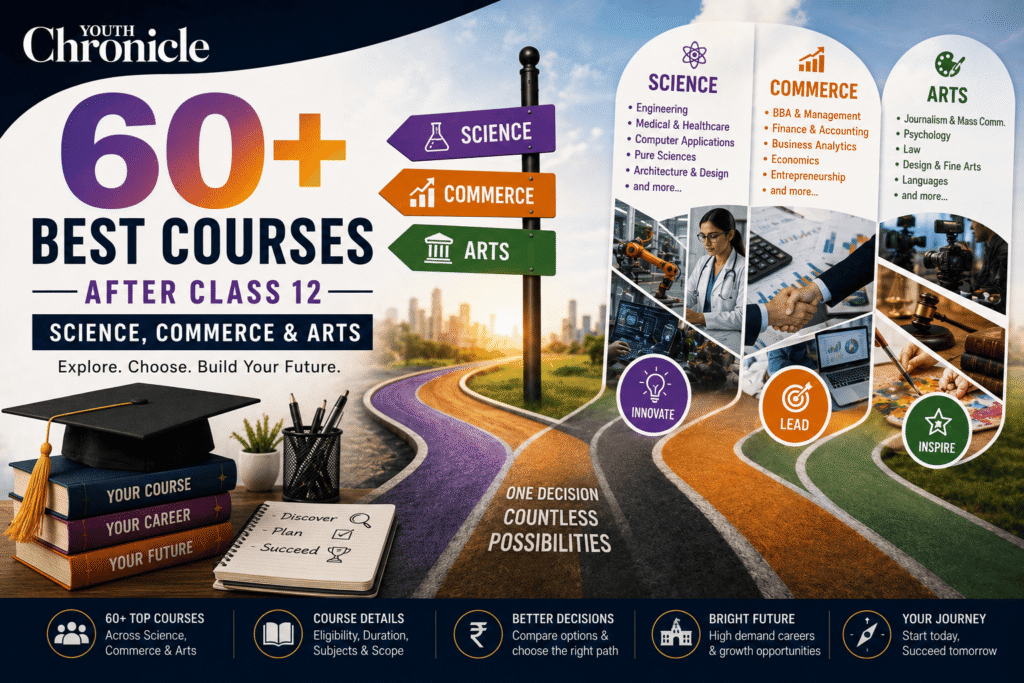
This guide covers 60+ courses after Class 12 for Science, Commerce and Arts students, along with eligibility considerations, entrance examinations, career directions and practical advice for making the right choice.
How to Choose the Best Course After Class 12
Before looking at individual courses, understand one important principle:
Do not choose a course only because it is popular.
Instead, evaluate it on five factors:
- Interest: Do you genuinely like the subject?
- Aptitude: Are your strengths suited to the field?
- Career path: What careers can the qualification lead to?
- Admission requirements: Do you meet the required subject and entrance-exam criteria?
- Long-term flexibility: Can you build additional skills or pursue higher education later?
A good career decision is therefore not simply about choosing a famous degree. It is about finding the intersection between interest, ability and opportunity.
Best Courses After Class 12 for Science Students
Science students generally have the widest range of options because their Class 12 subjects can provide eligibility for engineering, medicine, pure sciences, computing, architecture and several interdisciplinary programmes.
Science students can broadly be divided into PCM, PCB and PCMB groups.
Best Courses After 12th Science PCM
Students with Physics, Chemistry and Mathematics can consider engineering, architecture, computer applications, pure sciences, mathematics, design and several other fields.
1. B.Tech / B.E.
Duration: Usually 4 years
Engineering remains one of the most popular choices for PCM students.
Major specialisations include:
- Computer Science and Engineering
- Electronics and Communication Engineering
- Electrical Engineering
- Mechanical Engineering
- Civil Engineering
- Chemical Engineering
- Aerospace Engineering
- Biotechnology
- Information Technology
- Artificial Intelligence
- Data Science
Admission requirements vary by institution. JEE Main is a major national entrance examination for B.E./B.Tech admissions and also has separate papers for B.Arch and B.Planning.
2. B.Tech in Computer Science
Computer Science is particularly suitable for students interested in:
- Programming
- Software development
- Artificial intelligence
- Algorithms
- Cloud computing
- Cybersecurity
- Data systems
Students should not choose CSE solely because of its popularity. Programming and problem-solving should genuinely interest them.
3. B.Tech in Artificial Intelligence and Machine Learning
AI and machine learning programmes combine computer science, mathematics and statistics.
Students may study:
- Machine learning
- Data structures
- Programming
- Statistics
- Deep learning
- Artificial intelligence
- Computer vision
- Natural language processing
The exact curriculum varies considerably between institutions.
4. B.Tech in Data Science
Data Science focuses on extracting insights from large datasets.
Common areas include:
- Statistics
- Programming
- Data analysis
- Machine learning
- Database systems
- Data visualisation
It can be suitable for students who enjoy mathematics, statistics and technology.
5. B.Arch
Duration: Usually 5 years
Bachelor of Architecture is suitable for students interested in:
- Architecture
- Building design
- Urban environments
- Construction
- Spatial planning
- Design
Admission requirements vary by institution. JEE Main includes a Paper 2A for B.Arch and Paper 2B for B.Planning.
6. B.Planning
Students interested in cities, infrastructure and urban development can consider a Bachelor of Planning.
The field covers subjects related to:
- Urban planning
- Regional planning
- Infrastructure
- Transportation
- Housing
- Environmental planning
7. B.Sc Mathematics
A B.Sc in Mathematics can be a strong foundation for careers involving:
- Statistics
- Data analysis
- Actuarial studies
- Research
- Finance
- Teaching
- Higher education
Students interested in mathematics-heavy careers should consider this option alongside engineering.
8. B.Sc Physics
Physics graduates can pursue careers in research, education, technology and scientific fields, particularly after postgraduate study.
9. B.Sc Chemistry
Chemistry provides pathways into:
- Research
- Pharmaceuticals
- Chemical industries
- Quality control
- Laboratory work
- Higher education
10. B.Sc Computer Science
Students interested in technology but who do not necessarily want a B.Tech can consider B.Sc Computer Science.
The course generally covers programming, algorithms, databases, operating systems and computer fundamentals.
11. BCA
Bachelor of Computer Applications
BCA is a popular option for students interested in software and IT.
Subjects may include:
- Programming
- Web development
- Database management
- Computer networks
- Software engineering
Eligibility varies by university, so students should check whether Mathematics or another specific subject is required.
12. B.Sc Data Science
This combines statistics, mathematics, programming and data analysis.
It can be considered by students interested in analytics and technology.
13. B.Sc Statistics
Statistics is useful across:
- Data analytics
- Research
- Finance
- Economics
- Market research
- Government statistics
- Risk analysis
14. B.Des
Students interested in creative problem-solving can consider Bachelor of Design.
Specialisations may include:
- Product design
- Communication design
- Fashion design
- Interaction design
- Industrial design
- User experience design
Admission requirements differ between institutions.
15. Integrated M.Sc
Integrated five-year programmes can combine undergraduate and postgraduate study in fields such as:
- Physics
- Chemistry
- Mathematics
- Biology
- Computer Science
- Data-related disciplines
They can be particularly useful for students considering research or specialised higher education.
Best Courses After 12th Science PCB
Students with Physics, Chemistry and Biology have several options beyond MBBS.
16. MBBS
Bachelor of Medicine, Bachelor of Surgery
MBBS is the conventional medical degree for students seeking to become doctors.
For 2026, NEET-UG is the common and uniform entrance examination for undergraduate medical education in medical institutions. NTA also states that NEET applies to specified undergraduate AYUSH courses.
Medical education is a long-term commitment and requires significant academic effort, clinical training and professional responsibility.
17. BDS
Bachelor of Dental Surgery
BDS is the primary undergraduate route for students interested in dentistry.
NEET-UG is used for undergraduate dental admissions as prescribed under the applicable admission framework.
18. BAMS
Bachelor of Ayurvedic Medicine and Surgery
Students interested in Ayurveda can consider BAMS.
NEET-UG is also applicable to undergraduate BAMS admissions under the national framework.
19. BHMS
Bachelor of Homeopathic Medicine and Surgery
BHMS is another healthcare option for students interested in homeopathic medicine.
NEET-UG is applicable to BHMS admissions under the National Commission for Homoeopathy framework.
20. BUMS
Bachelor of Unani Medicine and Surgery
BUMS is an undergraduate medical programme in the Unani system of medicine.
NEET-UG applies to BUMS admissions under the relevant national framework.
21. BSMS
Bachelor of Siddha Medicine and Surgery
Students interested in Siddha medicine can consider BSMS.
NEET-UG is applicable to undergraduate BSMS admissions under the relevant framework.
22. B.Sc Nursing
B.Sc Nursing prepares students for professional nursing practice and healthcare roles.
Admission rules vary by institution and state. Students should check the relevant university or counselling authority.
For certain Armed Forces Medical Service B.Sc Nursing admissions, NTA states that NEET qualification is required for shortlisting.
23. B.Pharm
Bachelor of Pharmacy
B.Pharm is suitable for students interested in:
- Medicines
- Pharmaceutical manufacturing
- Drug development
- Quality control
- Healthcare products
- Regulatory work
Admission requirements vary by institution and state.
24. Pharm.D
Pharm.D is a professional pharmacy programme with a stronger clinical orientation.
Students should check the programme structure and recognition status of the institution before enrolling.
25. BPT
Bachelor of Physiotherapy
Physiotherapy focuses on rehabilitation and movement-related healthcare.
Students can work in hospitals, rehabilitation centres, clinics and sports-related environments, subject to applicable professional requirements.
26. B.Sc Biotechnology
Biotechnology combines biology with laboratory and technological applications.
Possible areas include:
- Molecular biology
- Genetics
- Microbiology
- Biochemistry
- Biomedical research
- Industrial biotechnology
27. B.Sc Microbiology
Microbiology focuses on microorganisms and their applications in healthcare, research, food, pharmaceuticals and industry.
28. B.Sc Biochemistry
Biochemistry studies the chemical processes underlying biological systems.
It can provide a foundation for research, healthcare-related laboratories, pharmaceuticals and higher studies.
29. B.Sc Zoology
Zoology focuses on animal biology and can lead towards research, education, environmental work and postgraduate study.
30. B.Sc Botany
Botany covers plant biology and can lead towards research, agriculture-related work, environmental fields and higher education.
31. B.Sc Environmental Science
Environmental Science combines biology, chemistry, geography and environmental studies.
Potential areas include:
- Environmental monitoring
- Sustainability
- Conservation
- Environmental consulting
- Research
- Policy
Best Courses After Class 12 for Commerce Students
Commerce students have strong pathways into finance, accounting, economics, management, business and law.
32. B.Com
Bachelor of Commerce
B.Com remains one of the most common undergraduate choices for commerce students.
Typical subjects include:
- Accounting
- Economics
- Business law
- Taxation
- Financial management
- Business studies
33. B.Com (Hons.)
B.Com (Hons.) generally provides a more specialised commerce curriculum.
It can be useful for students interested in:
- Finance
- Accounting
- Banking
- Consulting
- Corporate careers
- Higher education
34. Bachelor of Business Administration
BBA
BBA is designed around business and management.
Students may study:
- Marketing
- Finance
- Human resources
- Operations
- Entrepreneurship
- Business strategy
35. BBA in Business Analytics
This combines business studies with data analysis.
It can be useful for students interested in business intelligence, analytics and management decision-making.
36. BMS
Bachelor of Management Studies
BMS focuses on management, business and organisational studies.
It is particularly relevant for students considering management careers or an MBA later.
37. B.A. Economics
Economics is an option for students interested in:
- Finance
- Policy
- Economic research
- Banking
- Consulting
- Data and quantitative analysis
Students should check mathematics requirements carefully because some economics programmes require or strongly prefer Mathematics in Class 12.
38. Chartered Accountancy
The CA qualification is a professional route administered by the Institute of Chartered Accountants of India.
Students can begin the CA pathway after Class 12 through the applicable Foundation route. ICAI continues to publish Foundation examination and study information through its official channels.
CA is suitable for students interested in:
- Accounting
- Auditing
- Taxation
- Financial reporting
- Corporate finance
39. Company Secretary
The Company Secretary profession is administered by the Institute of Company Secretaries of India (ICSI).
The CSEET is part of the institute’s entry pathway, with the institute publishing eligibility and examination requirements for its sessions.
The field focuses on:
- Corporate law
- Compliance
- Governance
- Company administration
- Securities and regulatory matters
40. Cost and Management Accountancy
CMA is another professional route for students interested in:
- Cost accounting
- Management accounting
- Financial management
- Corporate strategy
- Performance management
The qualification is administered by the Institute of Cost Accountants of India.
41. Bachelor of Banking and Insurance
Some universities offer undergraduate programmes focused on banking and insurance.
These can be relevant for students interested in financial services.
42. Bachelor of Financial Markets
Students interested in capital markets, investment and financial services can explore undergraduate programmes specialising in financial markets where offered.
43. Bachelor of International Business
This programme focuses on:
- International trade
- Global markets
- Business strategy
- International finance
- Cross-border operations
44. BCA
Commerce students with the required subject background can also consider BCA at universities that permit their academic combination.
This can be useful for students interested in combining business knowledge with technology.
Best Courses After Class 12 for Arts and Humanities Students
Arts is no longer limited to a small set of conventional degree programmes.
Students can explore law, psychology, economics, media, design, social sciences, public policy and languages.
45. BA
Bachelor of Arts
BA offers an enormous range of subjects, including:
- Political Science
- History
- English
- Sociology
- Psychology
- Geography
- Philosophy
- Economics
- Hindi
- Languages
The quality and career value of a BA depend significantly on the subject, institution, skills developed and future plans.
46. BA Psychology
Psychology is increasingly popular among students interested in:
- Human behaviour
- Mental processes
- Research
- Organisational psychology
- Education
- Behavioural science
Students planning clinical or other regulated professional practice should understand that an undergraduate psychology degree alone does not automatically qualify someone for every psychology profession.
47. BA Political Science
Political Science is useful for students interested in:
- Public policy
- Government
- Civil services
- Research
- International relations
- Political analysis
48. BA History
History can provide a foundation for careers in education, research, museums, heritage, civil services, publishing and related fields.
49. BA English
English can lead towards areas such as:
- Writing
- Publishing
- Teaching
- Media
- Communication
- Content
- Research
50. BA Sociology
Sociology studies society, institutions, communities and social behaviour.
It can be relevant to:
- Social research
- Development organisations
- Public policy
- Civil services
- Academia
51. BA Journalism and Mass Communication
Students interested in media can pursue programmes covering:
- Journalism
- Digital media
- Television
- Radio
- Public relations
- Advertising
- Content production
52. BA LLB
Duration: Usually 5 years
BA LLB combines undergraduate-level humanities education with legal education.
It is suitable for students interested in:
- Litigation
- Corporate law
- Legal practice
- Judiciary preparation
- Policy
- Legal research
Admission requirements depend on the institution. Many leading law universities use the Common Law Admission Test (CLAT) or another institution-specific process.
53. BBA LLB
This combines business management with legal education.
It can be useful for students interested in:
- Corporate law
- Business
- Compliance
- Contracts
- Commercial practice
54. B.Des
Arts students interested in visual and creative fields can consider design programmes.
Possible specialisations include:
- Fashion
- Communication design
- Product design
- Graphic design
- Interaction design
- User experience
55. Bachelor of Fine Arts
BFA
BFA is suitable for students interested in:
- Painting
- Sculpture
- Applied arts
- Illustration
- Visual communication
- Other fine-art disciplines
56. Bachelor of Social Work
BSW
BSW prepares students for work related to:
- Community development
- Social welfare
- NGOs
- Development organisations
- Social services
57. Bachelor of Hotel Management
Hotel management can lead to careers in:
- Hospitality
- Hotels
- Restaurants
- Events
- Tourism
- Food service
58. Bachelor of Tourism Management
Students interested in tourism and travel can explore programmes covering:
- Tourism operations
- Travel management
- Hospitality
- Destination management
- Tourism marketing
59. Bachelor of Library and Information Science
Library and information science is an option for students interested in:
- Information management
- Libraries
- Digital repositories
- Documentation
- Knowledge management
60. BA International Relations
Where offered as a dedicated programme or specialisation, International Relations can suit students interested in:
- Diplomacy
- Foreign policy
- International organisations
- Global affairs
- Research
61. BA Public Policy
Public Policy programmes focus on how governments and institutions design and implement policies.
Possible areas include:
- Governance
- Economics
- Development
- Public administration
- Social policy
62. Bachelor of Journalism
Students who specifically want journalism can pursue a dedicated journalism degree where available.
The curriculum may include reporting, editing, media ethics, digital journalism and multimedia production.
63. Bachelor of Mass Communication
Mass communication programmes generally cover broader communication industries, including:
- Advertising
- Public relations
- Journalism
- Broadcasting
- Digital media
- Corporate communication
64. Bachelor of Fashion Design
Students interested in fashion can pursue undergraduate programmes in:
- Fashion design
- Textile design
- Apparel production
- Fashion communication
- Fashion merchandising
Diploma and Skill-Based Courses After Class 12
A three- or four-year degree is not the only route available.
Students can also consider diploma, certificate or industry-oriented programmes.
However, students should carefully check institutional recognition, curriculum quality and actual career outcomes before paying for a private certificate course.
Some useful areas include:
65. Digital Marketing
Topics can include:
- SEO
- Social media marketing
- Content marketing
- Performance advertising
- Analytics
66. Web Development
Students can learn:
- HTML
- CSS
- JavaScript
- Front-end development
- Back-end development
- Databases
67. Data Analytics
Students can develop skills in:
- Excel
- SQL
- Statistics
- Data visualisation
- Python
- Business analytics
68. UI/UX Design
This focuses on designing digital products and user experiences.
69. Graphic Design
Students can learn:
- Typography
- Layout
- Branding
- Illustration
- Digital design
70. Video Editing and Content Production
The growth of digital media has increased demand for skills involving:
- Video editing
- Motion graphics
- Short-form content
- Production
- Storytelling
These should generally be viewed as skills that complement a broader education, unless a student deliberately chooses a specialised vocational pathway.
Best Courses After 12th: Quick Comparison
| Course | Suitable Stream | Typical Duration | Broad Career Direction |
|---|---|---|---|
| B.Tech / B.E. | Science PCM | 4 years | Engineering & technology |
| MBBS | Science PCB | 5.5 years including internship | Medicine |
| BDS | Science PCB | Usually 5 years including internship | Dentistry |
| B.Pharm | Science | 4 years | Pharmacy |
| B.Sc | Science | Usually 3-4 years | Science, research, higher studies |
| BCA | Science/Commerce/others depending on university | Usually 3-4 years | IT & software |
| B.Arch | Science | 5 years | Architecture |
| B.Com | Commerce | Usually 3-4 years | Finance & commerce |
| BBA | Commerce/other eligible streams | Usually 3-4 years | Management & business |
| BA Economics | Multiple streams depending on university | Usually 3-4 years | Economics & finance |
| CA | Commerce/eligible streams | Professional pathway | Accounting & finance |
| CS | Commerce/eligible streams | Professional pathway | Corporate law & governance |
| CMA | Commerce/eligible streams | Professional pathway | Management accounting |
| BA | Arts/other eligible streams | Usually 3-4 years | Humanities & social sciences |
| BA LLB | Arts/other eligible streams | 5 years | Law |
| B.Des | Multiple streams depending on institution | Usually 4 years | Design |
| BJMC / Journalism | Arts/other eligible streams | Usually 3-4 years | Media |
| BSW | Arts/other eligible streams | Usually 3-4 years | Social sector |
| Hotel Management | Multiple streams | Usually 3-4 years | Hospitality |
| BFA | Arts/other eligible streams | Usually 4 years | Fine arts |
Important: Course duration and eligibility can differ between universities, so students should verify the specific institution’s admission rules.
Which Entrance Exams Should You Know After Class 12?
Your entrance-exam strategy should depend on the course you choose.
Engineering
JEE Main is the major national examination for B.E./B.Tech admissions to participating institutions, with separate papers for B.Arch and B.Planning.
Medicine
NEET-UG is the common national entrance examination for undergraduate medical education and is also applicable to specified AYUSH programmes.
University Admissions
CUET-UG is used by participating universities for undergraduate admissions, but each university can establish its own programme-wise eligibility and admission process. The NTA maintains the participating-university framework.
Law
Students should check whether their target law school accepts CLAT, AILET or another entrance examination.
Professional Courses
CA, CS and CMA follow their respective professional institutes’ admission and examination structures rather than being treated simply as conventional university degrees. ICAI and ICSI publish their own current examination and student information.
What Are the Best Courses After 12th for High-Paying Careers?
This is one of the most searched questions, but it requires a careful answer.
There is no course that guarantees a high salary.
Income depends on factors such as:
- College
- Skills
- Experience
- Location
- Industry
- Specialisation
- Professional qualifications
- Communication ability
- Market conditions
A B.Tech graduate may enter software, consulting, core engineering or research.
A B.Com graduate may enter accounting, banking, finance or business.
A BA graduate may enter education, policy, media, research or other fields.
Therefore, students should not select a course solely because an online article promises a particular salary.
Courses After 12th Without JEE or NEET
Students who do not want to pursue JEE or NEET have many alternatives.
Depending on eligibility, these can include:
- BCA
- B.Sc
- B.Com
- BBA
- BA
- B.Des
- BFA
- Journalism
- Hotel Management
- Social Work
- Economics
- Law
- Psychology
- Data-related programmes
- Management programmes
Not appearing for JEE or NEET does not mean that a student has limited career options.
What If You Are Confused About What to Do After Class 12?
If you are uncertain, do not make a decision immediately based on pressure from friends or relatives.
Instead, follow this process.
Step 1: Identify Your Strongest Subjects
Which subjects do you naturally understand better?
Step 2: Identify Activities You Enjoy
Do you prefer:
- Solving problems?
- Reading?
- Writing?
- Designing?
- Working with people?
- Working with numbers?
- Conducting experiments?
- Building technology?
Step 3: Shortlist Three Career Areas
For example:
Technology + Finance + Entrepreneurship
or
Medicine + Research + Healthcare
Step 4: Find Relevant Courses
Then compare the degrees that can take you towards those careers.
Step 5: Check Admission Requirements
Do not wait until applications open.
Check:
- Required Class 12 subjects
- Minimum marks
- Entrance examination
- Age requirements, where applicable
- University-specific rules
Step 6: Compare Colleges
Look at:
- Accreditation/recognition
- Curriculum
- Faculty
- Fees
- Placement information
- Internship opportunities
- Location
- Alumni network
- Higher-study opportunities
Common Mistakes Students Make After Class 12
Choosing a Course Because Everyone Else Is Doing It
Popularity is not proof of suitability.
Selecting a College Before Selecting a Course
A famous college cannot compensate for choosing a field you dislike.
Believing Salary Claims Without Checking the Source
Look for official placement reports, audited disclosures or credible institutional data.
Ignoring Course Eligibility
A student can have a strong CUET or entrance score and still be ineligible for a particular programme because of subject requirements.
Spending Large Amounts on Unverified Courses
Before enrolling in a private skill programme, verify what exactly you receive and whether the qualification has meaningful recognition.
Thinking a Degree Alone Guarantees Employment
Students increasingly need a combination of:
Degree + practical skills + communication + internships/projects + adaptability.
Final Verdict: Which Is the Best Course After Class 12?
There is no single answer to the question “Which is the best course after Class 12?”
For one student, B.Tech may be the right choice. For another, MBBS may be the better path. A commerce student may thrive in CA or finance, while another may prefer management or entrepreneurship. An arts student may find greater potential in law, psychology, design, economics, journalism or public policy.
The most important decision is therefore not to find the course that sounds most prestigious.
It is to find the course that matches your ability, interest and long-term career objective.
Before making your final choice, compare at least three options and investigate the actual curriculum, admission requirements, cost and career pathways.
For 2026 admissions, students should rely on official examination authorities, universities and professional institutes for final eligibility and admission information. Entrance requirements can change, and a course that accepts one subject combination at one university may have different requirements at another.
Your Class 12 stream does not define your entire career.
What matters is the quality of the decision you make after it.
Frequently Asked Questions
Which is the best course after Class 12 Science?
Popular options include B.Tech, MBBS, BDS, B.Pharm, B.Sc, BCA, B.Arch, biotechnology and other specialised programmes. The right choice depends on whether you prefer engineering, medicine, research, technology or another field.
Which course is best after Class 12 Commerce?
B.Com, B.Com (Hons.), BBA, BMS, Economics, CA, CS, CMA, finance and business analytics are among the major options.
Which course is best after Class 12 Arts?
BA programmes, law, psychology, economics, journalism, design, social work, public policy, international relations and management are possible options depending on eligibility.
Can Science students pursue Commerce or Arts courses?
Yes, many universities allow students from different Class 12 streams to apply for certain humanities, commerce or management programmes. However, eligibility is university- and course-specific.
Can Commerce students pursue BCA?
In many institutions, yes, but eligibility varies. Some universities require Mathematics or Computer Science at Class 12 level, while others have different requirements.
Can Arts students pursue law?
Yes. Five-year integrated law programmes such as BA LLB are available to eligible Class 12 graduates. The admission process depends on the law school.
Which courses can I pursue without JEE or NEET?
Depending on eligibility, options include BCA, B.Sc, B.Com, BBA, BA, B.Des, BFA, journalism, hotel management, law and many other programmes.
Should I choose a course based on salary?
Salary should be one consideration, not the only one. Skills, institution, experience, specialisation and industry significantly affect career outcomes.
Is a degree enough to get a good job?
Not necessarily. Students should develop practical skills, internships, projects, communication ability and relevant technical or professional knowledge alongside their degree.
What should I do if I am still confused?
Shortlist three possible career areas, research the courses leading to them, compare eligibility and costs, speak with qualified professionals or counsellors, and avoid making the decision purely because of social pressure.
The Bottom Line
There are 60+ meaningful course options after Class 12, and the list becomes even larger when specialised degrees, professional qualifications, vocational programmes and skill-based education are considered.
The goal is not to find the course that everyone calls “best.”
The goal is to find the course that is best for you.